
SDG 9 · Industry, Innovation and Infrastructure
The signal reaches 96% of the world. A quarter of people still aren't online.
Eco Heroes turns that fact into a story a 9-year-old can hold onto: The Maths Game, book 9 of 17 in the SDG Library.
The target, in plain language
What the UN actually promised
Significantly increase access to information and communications technology and strive to provide universal and affordable access to the Internet in least developed countries by 2020.
Target 9.1 asks for quality, reliable, sustainable and resilient infrastructure (roads, power, water and digital networks) with affordable and equal access for all.
Why it matters
The number behind the story
Source: The Sustainable Development Goals Report 2026, UN DESA. Figures as published in July 2026.
The story
The Maths Game
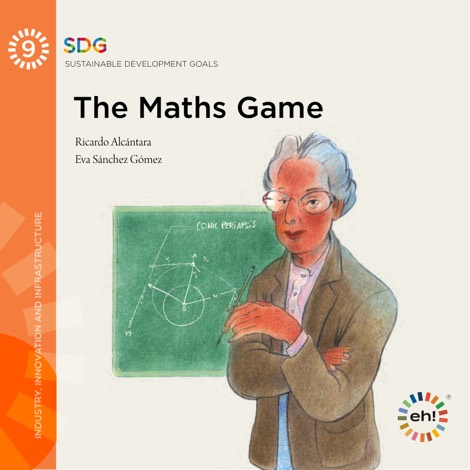
The Maths Game
Book 9 of 17 in the Eco Heroes SDG Library, one illustrated story for each UN Sustainable Development Goal. Included with any Eco Heroes plan (families from €79 a year + VAT: €95.59 with 21% Spanish VAT; the VAT and the total that apply to you are shown before you pay); SDG 1 is free to try. Published in English, Spanish, French, German, Italian, Portuguese, Catalan, Danish, Dutch, Japanese, Korean and Chinese.
Bring it into the room
Talk about it, try it
One question to ask after reading
“If you could keep only one invention, which would it be? And who in the world still doesn't have it?”
Invent a fix
In pairs, pick one everyday problem at school or on your street and sketch an invention that solves it using only things you could find nearby. Pitch it in 60 seconds.
Watch
The short mission video
April and Karim walk through this goal in a short video, with subtitles in your language.
Transcript
Everything said in the video, in order, with the words and figures shown on screen.
Version for ages 9–12
- April: Build smart. Connect everyone. An Eco Heroes mission.
- On screen: An Eco Heroes mission · Goal 9 · ages 9–12
- On screen: See something real
- April: Good design must survive the real world. Who decided how our bridges, roads and internet were built?
- On screen: A real question is where every mission starts.
- On screen: Investigate the system
- Karim: Innovation & Infrastructure is a system, not a headline.
- On screen: 2.6B people are still not connected to the internet. (Source: ITU, 2023)
- Karim: 2.6 billion people are still not connected to the internet. of humanity lacks reliable access to the internet's opportunities.
- On screen: 1 / 3 of humanity lacks reliable access to the internet's opportunities. (Source: ITU, 2023)
- On screen: 16% of the world's people have no mobile broadband coverage where they live. (Source: ITU, 2023)
- On screen: Step 4 · Meet someone who understands it
- Karim: Ask the people who know: an engineer, a maker-space or repair café, a bus driver.
- April: Your mission — Build It Strong. Become a young engineer with a real challenge. Do: Build a bridge from paper or straws to hold a small toy.
- On screen: Prove: Test how much weight it holds before it bends.
- On screen: Reflect: What made it stronger?
- April: Bring it to school.
- On screen: Bring it to school: Show your class what you found. One finding from each of you becomes a map of your town.
- April: Show your class what you found. Discuss it at home.
- On screen: Discuss it at home: Tell your family what you did and ask them one question about it. Information fades — questions travel.
- April: Tell your family what you did and ask them one question about it. Take action locally.
- On screen: Take action locally: Pick the one action from your mission you can do this week — and tell one person why.
- Karim: A true story — The Bridge Builder. A bridge is not steel and rope — it's access to everything on the other side.
- On screen: Small hands. Real problem. Real change.
- Karim: 17 goals, 13 languages, one hero: your child. eco-heroes.org
- On screen: eco-heroes.org/game
Version for ages 13–17
- April: Who gets online shapes who gets ahead.
- On screen: An Eco Heroes mission · Goal 9 · ages 13–17
- On screen: Notice something real
- April: 2.2 billion people are still not online. Who decides where the internet, roads and power lines go?
- On screen: Hard questions are where real missions start.
- On screen: Map the system
- Karim: Infrastructure is a system: money, planning and who gets left out. Only 23 percent of people in low-income countries use the internet, compared with
- On screen: 23% of people in low-income countries use the internet. (Source: ITU, 2025)
- On screen: 4% 5G coverage in low-income countries. (Source: ITU, 2025)
- On screen: 2.2B people are still offline. (Source: ITU, 2025)
- On screen: Step 4 · Talk to someone who knows
- Karim: 94 percent in high-income countries. Interview someone who knows: a civil engineer, a network technician, a town planner.
- April: Your mission — Connection Map. Map who in your area is well connected — and who isn't.
- On screen: Do: Test mobile signal and internet speed at ten places around town.
- On screen: Prove: Plot the results on a map.
- On screen: Reflect: Who loses out where the signal is weakest?
- April: Take it to school.
- On screen: Take it home: Ask your family which services they can only use online.
- On screen: Act where you live: Send your map to your council or help someone get online.
- On screen: Real data. Real questions. Real change.
- April: Share your map and compare it with a rural or poorer region. Then take it home, and act where you live.
- Karim: A true story. A bridge is not steel and rope — it's access to everything on the other side. 17 goals, 13 languages, your move. eco-heroes.org
How Estonia built the world's most digital country
Estonia digitalised its entire government after independence in 1991. Today 99% of public services are online, citizens vote digitally, and startups like Skype and TransferWise emerged from this culture of innovation.
Quick check
Test yourself
What does innovation mean in the context of SDG 9?Show the answer
- Copying old ideas
- Creating new solutions to persistent problems
- Studying harder than before
- Buying the newest things
Answer: Creating new solutions to persistent problems — Innovation means developing new ideas, methods and technologies that solve problems more effectively.
Nearly half the world still lacks reliable access to the internet.Show the answer
Answer: True — About 3.5 billion people — mostly in low-income countries — still lack internet access, creating a significant digital divide.
What is circular economy design?Show the answer
- Designing products for the bin
- Designing out waste so materials stay in use
- A type of architecture
- Circular marketing
Answer: Designing out waste so materials stay in use — Circular economy design creates products and systems where waste is designed out — materials are reused, repaired and recycled.
Go further
Seventeen goals, seventeen stories
Every SDG gets its own illustrated book, its own facts and its own activities. SDG 1 is free to try: its game chapter, trivia and video. The books and the other goals unlock with a family, school or hotel plan.
See plans →