
Reading guide · Goal 9 · Innovation & Infrastructure
The Maths Game
Ages 6 to 14
A free reading guide for families and teachers: questions by age, vocabulary and activities.
About the story
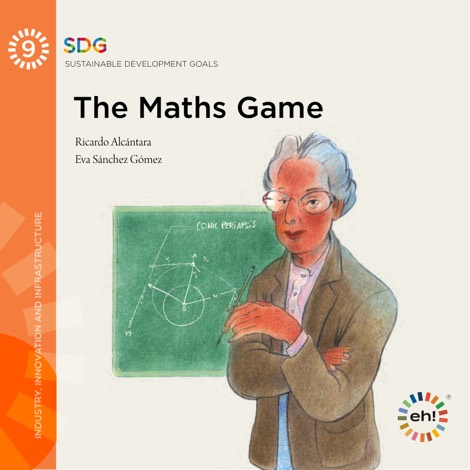
One day Abril notices a smell of sadness in the air and follows it to a modest house in the United States, where the Colemans live with their four children. Katherine, the youngest, has a special talent for maths, but she is a girl with dark skin at a time when both are hard barriers to get past. Abril decides that talent must not be wasted. She leaves a notebook beside Katherine with a sentence she has started, and the two of them begin a game: one writes the beginning, the other finishes it. Page by page the notebook tells Katherine's future: a university where teachers help her shine, teaching at a small school, rude looks in a mostly white city, and a job as a human calculator at the National Advisory Committee for Aeronautics, which later becomes NASA. There she has to fight to attend meetings and to sign her own reports. Where will the game take her? The story is inspired by Katherine Johnson, whose calculations helped launch the first American space flights.
Themes to talk about
- Talent that must not be wasted
- Overcoming barriers of race and gender
- Maths as a game and a way to understand the world
- Science, innovation and the space race
- Katherine Johnson and NASA
Questions to discuss
Ages 6 to 8
- What game do Abril and Katherine play with the notebook?
- Katherine finds maths as natural as breathing. What comes naturally to you?
- At NASA, Katherine is bored at first reading data from aeroplane black boxes. What does she tell herself to stay patient?
- What news does Katherine's father give the four children at the end of the story? Why do you think they cheer?
Ages 9 to 11
- Why were being a girl and having dark skin such big obstacles for Katherine?
- Katherine asks to attend a department meeting with the men. Why are her colleagues surprised? Why does nobody stop her?
- Katherine and her African American colleagues had to work, eat and use the toilets apart from white colleagues. Why do you think she said it was no big deal?
- How does Ted help Katherine become the first woman in the department to sign a report?
Ages 12 to 14
- Abril writes in the notebook, 'Talent mustn't be wasted.' What is lost, for everyone, when someone's talent is held back by prejudice?
- Katherine says that if hurdles had stopped them, her family would never have left their village. What does she mean?
- As a teacher, Katherine encouraged children to be curious and to ask as many times as they needed. Why does that matter for innovation?
- Research the first American space flights. What did Katherine Johnson calculate, and why did the astronauts trust her numbers?
Words to learn
- talent
- A natural ability to do something very well.
- calculation
- Working out an answer using numbers.
- mathematician
- A person who studies and uses maths to solve problems.
- trajectory
- The curved path something follows as it flies through the air or space.
- orbit
- The path a spacecraft, moon or planet takes around another body in space.
- aeronautics
- The science of building and flying aircraft.
- NASA
- The United States space agency, which grew out of the National Advisory Committee for Aeronautics.
- prejudice
- An unfair opinion about someone formed without knowing them, often because of their race or sex.
- innovation
- A new idea, method or invention that changes how things are done.
Activities
20 minutes
The notebook game
Materials
- A notebook
- A pencil
Steps
- In pairs, one person writes the start of a sentence about someone's future, as Abril does.
- The other person finishes it without talking first.
- Swap and carry on until you have written a short story together.
- Read it aloud. Talk about how it felt to have someone else shape your story.
25 minutes
Human calculators
Materials
- A ball
- A stopwatch
- A tape measure
- Paper and pencils
Steps
- Outdoors, throw a ball gently forwards and measure how far it lands. Repeat three times.
- Time how long it stays in the air, and work out the average of your three throws.
- Try to predict where the next throw will land before you make it.
- Talk about why space flights needed people like Katherine to predict a path exactly.
25 minutes
Hidden figures in your street
Materials
- Paper and pencils
- Access to books or the internet with an adult
Steps
- Look around your home or school for things that needed maths and engineering: bridges, phones, buses, buildings.
- Choose one and find out who helped design or invent it.
- Check whether that person was a woman, or someone whose work went unnoticed for years, as Katherine's did at first.
- Make a poster that gives that person the credit they deserve.
The link with SDG 9
Goal 9 aims to build resilient infrastructure, promote sustainable industry and foster innovation, and Target 9.5 calls for more scientific research and more people working in research and development. The Maths Game shows what is lost when talent is shut out: Katherine's calculations helped lay the foundations for space flight, but only because she kept pushing past barriers that kept women and African Americans out of science.
All about SDG 9: Innovation & Infrastructure →Frequently asked questions
What age is The Maths Game for?
This guide offers questions for three age bands: 6 to 8, 9 to 11 and 12 to 14. Younger children enjoy the notebook game between Abril and Katherine; older readers can explore segregation and the history of space flight.
Which Sustainable Development Goal does The Maths Game cover?
It covers Goal 9, Industry, Innovation and Infrastructure, through a story inspired by Katherine Johnson, the mathematician whose calculations helped launch the first American space flights.
Where can we read The Maths Game?
The full book is in the Eco Heroes library, available to members with a family or school plan. This reading guide is public and can be used by anyone at home or in class.
Read the whole book
“The Maths Game” is in the Eco Heroes library for members with a family or school plan. This guide is public: use it freely at home or in class.