
SDG 12 · Responsible Consumption and Production
Over a billion tons of food are thrown away every year.
Eco Heroes turns that fact into a story a 9-year-old can hold onto: A Chicken Thigh, book 12 of 17 in the SDG Library.
The target, in plain language
What the UN actually promised
By 2030, halve per capita global food waste at the retail and consumer levels and reduce food losses along production and supply chains, including post-harvest losses.
Target 12.5: substantially reduce waste through prevention, reduction, recycling and reuse. Electronic waste alone has reached 65 million tons a year, and less than a quarter is formally recycled.
Why it matters
The number behind the story
Source: The Sustainable Development Goals Report 2026, UN DESA. Figures as published in July 2026.
The story
A Chicken Thigh
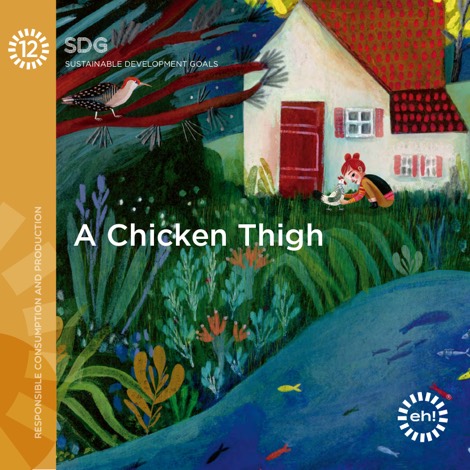
A Chicken Thigh
Book 12 of 17 in the Eco Heroes SDG Library, one illustrated story for each UN Sustainable Development Goal. Included with any Eco Heroes plan (families from €79 a year + VAT: €95.59 with 21% Spanish VAT; the VAT and the total that apply to you are shown before you pay); SDG 1 is free to try. Published in English, Spanish, French, German, Italian, Portuguese, Catalan, Danish, Dutch, Japanese, Korean and Chinese.
Bring it into the room
Talk about it, try it
One question to ask after reading
“What did you throw away last week that could have been eaten, fixed or passed on to someone else?”
Become bin detectives
After lunch, sort what's left into “could have been eaten”, “could be composted” and “real rubbish”. Count or weigh each pile, then set one goal for next week.
Watch
The short mission video
April and Karim walk through this goal in a short video, with subtitles in your language.
Transcript
Everything said in the video, in order, with the words and figures shown on screen.
Version for ages 9–12
- April: Use less. Waste nothing. An Eco Heroes mission.
- On screen: An Eco Heroes mission · Goal 12 · ages 9–12
- On screen: See something real
- April: Most 'rubbish' could be reused or recycled. Where does my old T-shirt go when I throw it away?
- On screen: A real question is where every mission starts.
- On screen: Investigate the system
- Karim: Responsible Consumption is a system, not a headline. 1.7 Earths' worth of resources humanity uses every year.
- On screen: 1.7 Earths' worth of resources humanity uses every year. (Source: Global Footprint Network, 2023)
- Karim: of all food produced is wasted along the chain.
- On screen: 1 / 3 of all food produced is wasted along the chain. (Source: UNEP, 2024)
- On screen: 62Mt of electronic waste is generated yearly — and most isn't recycled. (Source: UN Global E-waste Monitor, 2024)
- On screen: Step 4 · Meet someone who understands it
- Karim: Ask the people who know: a recycling-centre worker, a second-hand shop, a repair café.
- April: Your mission — Trash Detective. Investigate what your bin is really full of. Do: Sort one day's household waste into groups.
- On screen: Prove: Note what could have been reused or recycled.
- On screen: Reflect: What was the biggest surprise?
- April: Bring it to school.
- On screen: Bring it to school: Show your class what you found. One finding from each of you becomes a map of your town.
- April: Show your class what you found. Discuss it at home.
- On screen: Discuss it at home: Tell your family what you did and ask them one question about it. Information fades — questions travel.
- April: Tell your family what you did and ask them one question about it. Take action locally.
- On screen: Take action locally: Pick the one action from your mission you can do this week — and tell one person why.
- Karim: A true story — The Repair Revolution. The greenest product is the one you don't have to buy again.
- On screen: Small hands. Real problem. Real change.
- Karim: 17 goals, 13 languages, one hero: your child. eco-heroes.org
- On screen: eco-heroes.org/game
Version for ages 13–17
- April: We use 1.73 Earths.
- On screen: An Eco Heroes mission · Goal 12 · ages 13–17
- On screen: Notice something real
- April: We only have one. In 2026, humanity used up a whole year of nature's budget by 30 July. Where does everything we buy come from — and where does it go?
- On screen: Hard questions are where real missions start.
- On screen: Map the system
- Karim: Consumption is a system: design, adverts, prices and the bin. In 2022 the world made a record 62 million tonnes of e-waste, and only 22.3 percent
- On screen: 22.3% of the world's e-waste is properly recycled. (Source: UN E-waste Monitor, 2024)
- On screen: 1B meals' worth of food is wasted every day. (Source: UNEP, 2024)
- On screen: 1.73 Earths' worth of nature used each year. (Source: Footprint Network, 2026)
- On screen: Step 4 · Talk to someone who knows
- Karim: was properly recycled. Interview someone who knows: a repair-café volunteer, a recycling worker, a second-hand shop owner.
- April: Your mission — Life of a Product. Follow one product from raw material to rubbish.
- On screen: Do: Pick something you own and research its materials, factory and end of life.
- On screen: Prove: Map its journey and estimate its footprint.
- On screen: Reflect: Could it be repaired, shared or skipped?
- April: Take it to school.
- On screen: Take it home: Audit one cupboard at home: what could be repaired or passed on?
- On screen: Act where you live: Map the repair cafés and second-hand shops near you and share it.
- On screen: Real data. Real questions. Real change.
- April: Run a swap or repair day with your class. Then take it home, and act where you live.
- Karim: A true story. The greenest product is the one you don't have to buy again. 17 goals, 13 languages, your move. eco-heroes.org
Patagonia's anti-consumption business model
Patagonia, the outdoor clothing brand, launched a campaign saying "Don't Buy This Jacket" — encouraging customers to repair, reuse and recycle instead. It increased brand loyalty and reduced their environmental footprint.
Quick check
Test yourself
What is the correct order of the 3Rs?Show the answer
- Recycle, Reuse, Reduce
- Reduce, Reuse, Recycle
- Reuse, Reduce, Recycle
- Recycle, Reduce, Reuse
Answer: Reduce, Reuse, Recycle — Reduce first, then Reuse, then Recycle — because reducing consumption at the source has the greatest impact.
Fast fashion is one of the world's most polluting industries.Show the answer
Answer: True — The fashion industry produces 10% of global carbon emissions, 20% of wastewater and 35% of ocean microplastics.
What is a lifecycle assessment (LCA)?Show the answer
- A birth certificate
- Evaluating a product's full environmental impact from creation to disposal
- A financial audit
- A health assessment
Answer: Evaluating a product's full environmental impact from creation to disposal — An LCA measures the total environmental impact of a product across its entire life — from raw materials to end of life.
Go further
Seventeen goals, seventeen stories
Every SDG gets its own illustrated book, its own facts and its own activities. SDG 1 is free to try: its game chapter, trivia and video. The books and the other goals unlock with a family, school or hotel plan.
See plans →