
🎬 short mission video
Every goal, explained in a short video — in your language.
SDG 13 · Climate Action
The planet is already about 1.4°C warmer.
Eco Heroes turns that fact into a story a 9-year-old can hold onto: His Name is Murphy!, book 13 of 17 in the SDG Library.
The target, in plain language
What the UN actually promised
Strengthen resilience and adaptive capacity to climate-related hazards and natural disasters in all countries.
Target 13.3 is about education: improve awareness and the ability to reduce, adapt to and warn early about climate change. That one starts in classrooms.
Why it matters
The number behind the story
Single years swing up and down; the long-term warming level is about 1.4°C (Copernicus). Copernicus, 2026.
Source: The Sustainable Development Goals Report 2026, UN DESA. Figures as published in July 2026.
The story
His Name is Murphy!
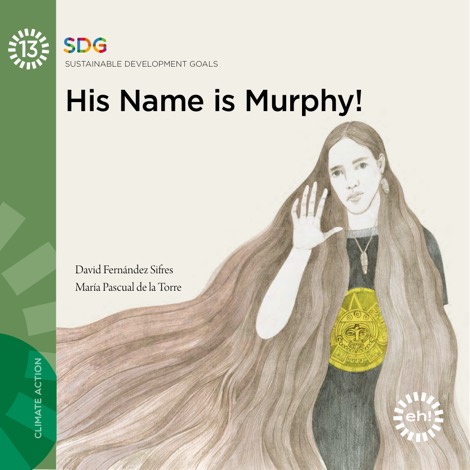
His Name is Murphy!
Book 13 of 17 in the Eco Heroes SDG Library, one illustrated story for each UN Sustainable Development Goal. Included with any Eco Heroes plan (families from €79 a year + VAT: €95.59 with 21% Spanish VAT; the VAT and the total that apply to you are shown before you pay); SDG 1 is free to try. Published in English, Spanish, French, German, Italian, Portuguese, Catalan, Danish, Dutch, Japanese, Korean and Chinese.
Bring it into the room
Talk about it, try it
One question to ask after reading
“What kind of extreme weather could happen where you live? And who would need help first?”
Make a ready plan
Write one page together: where to meet, who to call and three things to grab if a storm, flood or heatwave hit. Stick it somewhere everyone can see it.
Watch
The short mission video
April and Karim walk through this goal in a short video, with subtitles in your language.
Transcript
Everything said in the video, in order, with the words and figures shown on screen.
Version for ages 9–12
- April: Our planet. Our moment. An Eco Heroes mission.
- On screen: An Eco Heroes mission · Goal 13 · ages 9–12
- On screen: See something real
- April: Everyday choices add up to a carbon footprint. Why is the weather changing — and what can my family do?
- On screen: A real question is where every mission starts.
- On screen: Investigate the system
- Karim: Climate Action is a system, not a headline. Earth has already warmed ~1.4°C above pre-industrial levels.
- On screen: 1.4°C Earth has already warmed ~1.4°C above pre-industrial levels. (Source: Copernicus, 2026)
- Karim: The ten warmest years on record all happened in the last decade.
- On screen: 10/10 The ten warmest years on record all happened in the last decade. (Source: WMO, 2024)
- On screen: 3.4B people live in places highly vulnerable to climate impacts. (Source: IPCC, 2022)
- On screen: Step 4 · Meet someone who understands it
- Karim: Ask the people who know: a weather station or meteorologist, a firefighter, a climate group.
- April: Your mission — Carbon Footprint Hunt. Find the carbon hiding in your day. Do: List things you did today that used energy or fuel.
- On screen: Prove: Circle 3 you could change.
- On screen: Reflect: Which change is easiest to keep?
- April: Bring it to school.
- On screen: Bring it to school: Show your class what you found. One finding from each of you becomes a map of your town.
- April: Show your class what you found. Discuss it at home.
- On screen: Discuss it at home: Tell your family what you did and ask them one question about it. Information fades — questions travel.
- April: Tell your family what you did and ask them one question about it. Take action locally.
- On screen: Take action locally: Pick the one action from your mission you can do this week — and tell one person why.
- Karim: A true story — The Schoolgirl Who Sparked a Movement. No one is too small to make a difference.
- On screen: Small hands. Real problem. Real change.
- Karim: 17 goals, 13 languages, one hero: your child. eco-heroes.org
- On screen: eco-heroes.org/game
Version for ages 13–17
- April: The heat is on.
- On screen: An Eco Heroes mission · Goal 13 · ages 13–17
- On screen: Notice something real
- April: So are we. 2025 was the third-hottest year ever measured — and 2023 to 2025 together passed 1.5°C. If everyone knows about climate change, why are emissions still so high?
- On screen: Hard questions are where real missions start.
- On screen: Map the system
- Karim: Climate is a system: energy, food, transport, money and votes. Earth's long-term warming is now about 1.4°C above pre-industrial levels.
- On screen: 1.4°C long-term warming above pre-industrial levels. (Source: Copernicus, 2026)
- On screen: 1.6°C in 2024, the first calendar year above 1.5°C. (Source: Copernicus, 2025)
- On screen: ~2030 when the Paris 1.5°C limit could be reached at this pace. (Source: Copernicus, 2026)
- On screen: Step 4 · Talk to someone who knows
- Karim: Interview someone who works on it: an energy engineer, a local councillor, a climate scientist.
- April: Your mission — Emissions Audit. Find where your school's emissions really come from.
- On screen: Do: Track your school's energy, heating and travel for one week.
- On screen: Prove: Turn it into one chart showing the three biggest sources.
- On screen: Reflect: Which source could your school cut — and who decides?
- April: Take it to school.
- On screen: Take it home: Show your family the numbers and ask which change they would actually keep.
- On screen: Act where you live: Write to your council or join a climate group — one concrete ask, backed by your data.
- On screen: Real data. Real questions. Real change.
- April: Present your chart to the student council and propose one change. Then take it home, and act where you live.
- Karim: A true story. No one is too small to make a difference. 17 goals, 13 languages, your move. eco-heroes.org
Costa Rica: electricity almost without fossil fuels
Costa Rica has generated more than 95% of its electricity from renewable sources every year since 2015, mainly hydro, geothermal and wind, and its National Decarbonisation Plan sets a net-zero target for 2050.
Quick check
Test yourself
What primarily causes the current climate crisis?Show the answer
- Too much rain
- Greenhouse gas emissions from human activity
- Volcanic eruptions only
- The moon's gravity
Answer: Greenhouse gas emissions from human activity — The scientific consensus is clear — the current climate crisis is primarily caused by human greenhouse gas emissions from fossil fuels, deforestation and industry.
The Paris Agreement aims to keep global warming well below 2°C and to pursue efforts to limit it to 1.5°C.Show the answer
Answer: True — The 2015 Paris Agreement commits countries to keep warming well below 2°C above pre-industrial levels and to pursue efforts to limit it to 1.5°C, the level beyond which climate impacts grow sharply.
What does "carbon neutrality" mean?Show the answer
- Producing zero CO₂ ever
- Balancing emissions with removals so the net is zero
- A type of fuel
- A renewable energy source
Answer: Balancing emissions with removals so the net is zero — Carbon neutrality means balancing the carbon you emit with an equivalent amount removed from the atmosphere.
Go further
Seventeen goals, seventeen stories
Every SDG gets its own illustrated book, its own facts and its own activities. SDG 1 is free to try: its game chapter, trivia and video. The books and the other goals unlock with a family, school or hotel plan.
See plans →