
🎬 short mission video
Every goal, explained in a short video — in your language.
SDG 14 · Life Below Water
More than a third of the world's fish stocks are overfished.
Eco Heroes turns that fact into a story a 9-year-old can hold onto: Glasses to Another World, book 14 of 17 in the SDG Library.
The target, in plain language
What the UN actually promised
By 2020, effectively regulate harvesting and end overfishing, illegal, unreported and unregulated fishing and destructive fishing practices…
Target 14.1 asks the world to prevent and significantly reduce marine pollution of all kinds, especially from land, including the litter that washes from our streets into the sea.
Why it matters
The number behind the story
Source: The Sustainable Development Goals Report 2026, UN DESA. Figures as published in July 2026.
The story
Glasses to Another World
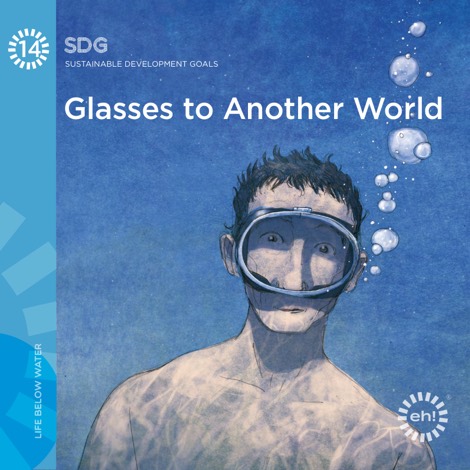
Glasses to Another World
Book 14 of 17 in the Eco Heroes SDG Library, one illustrated story for each UN Sustainable Development Goal. Included with any Eco Heroes plan (families from €79 a year + VAT: €95.59 with 21% Spanish VAT; the VAT and the total that apply to you are shown before you pay); SDG 1 is free to try. Published in English, Spanish, French, German, Italian, Portuguese, Catalan, Danish, Dutch, Japanese, Korean and Chinese.
Bring it into the room
Talk about it, try it
One question to ask after reading
“If fish could vote, what's the one rule they would ask humans to follow?”
Follow the litter
Pick one piece of litter near your school gate. Which drain would it go down, which river would carry it, which sea would it reach? Trace the journey on a map and draw it.
Watch
The short mission video
April and Karim walk through this goal in a short video, with subtitles in your language.
Transcript
Everything said in the video, in order, with the words and figures shown on screen.
Version for ages 9–12
- April: Protect the blue heart of the planet. An Eco Heroes mission.
- On screen: An Eco Heroes mission · Goal 14 · ages 9–12
- On screen: See something real
- April: Most ocean plastic starts on land. Where does the plastic in the sea come from?
- On screen: A real question is where every mission starts.
- On screen: Investigate the system
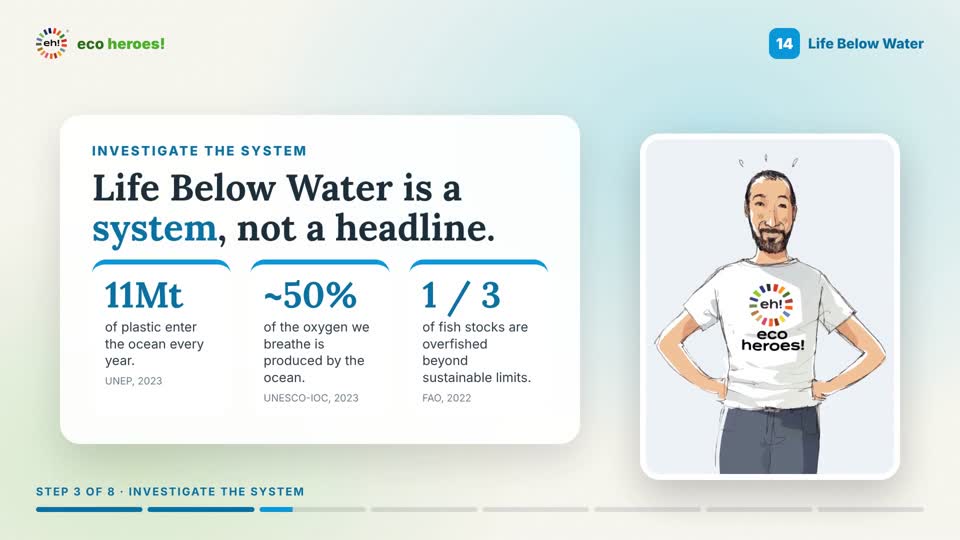
- Karim: Life Below Water is a system, not a headline.
- On screen: 11Mt of plastic enter the ocean every year. (Source: UNEP, 2023)
- Karim: 11 milliont of plastic enter the ocean every year. ~50% of the oxygen we breathe is produced by the ocean.
- On screen: ~50% of the oxygen we breathe is produced by the ocean. (Source: UNESCO-IOC, 2023)
- On screen: 1 / 3 of fish stocks are overfished beyond sustainable limits. (Source: FAO, 2022)
- On screen: Step 4 · Meet someone who understands it
- Karim: Ask the people who know: a fisher, a lifeguard, a beach-cleanup group.
- April: Your mission — The Plastic Interceptor. Stop plastic before it reaches the sea. Do: Collect plastic litter from one area near you (safely).
- On screen: Prove: Count and sort what you found.
- On screen: Reflect: Where did most of it come from?
- April: Bring it to school.
- On screen: Bring it to school: Show your class what you found. One finding from each of you becomes a map of your town.
- April: Show your class what you found. Discuss it at home.
- On screen: Discuss it at home: Tell your family what you did and ask them one question about it. Information fades — questions travel.
- April: Tell your family what you did and ask them one question about it. Take action locally.
- On screen: Take action locally: Pick the one action from your mission you can do this week — and tell one person why.
- Karim: A true story — Her Deepness. No water, no life.
- On screen: Small hands. Real problem. Real change.
- Karim: No blue, no green. Sylvia Earle. 17 goals, 13 languages, one hero: your child. eco-heroes.org
- On screen: eco-heroes.org/game
Version for ages 13–17
- April: The ocean keeps us alive.
- On screen: An Eco Heroes mission · Goal 14 · ages 13–17
- On screen: Notice something real
- April: Return the favour. Most ocean plastic starts on land — in our streets, drains and rivers. Who is really responsible for the plastic in the ocean — us, companies or
- On screen: Hard questions are where real missions start.
- On screen: Map the system
- April: governments?
- Karim: The ocean is a system: what we make, buy and throw away ends up in it. 19 to 23 million tonnes of plastic waste reach rivers, lakes and seas each year.
- On screen: ~20Mt of plastic waste reach rivers, lakes and seas each year. (Source: UNEP)
- On screen: 38% of assessed fish stocks are overfished. (Source: FAO SOFIA, 2026)
- On screen: ~50% of the oxygen we breathe is produced by the ocean. (Source: UNESCO-IOC)
- On screen: Step 4 · Talk to someone who knows
- Karim: Interview someone who knows: a marine biologist, a fisher, a beach-cleanup organiser.
- April: Your mission — Plastic Source Tracker. Trace your local litter back to the companies that made it.
- On screen: Do: Log 50 pieces of litter near a drain, river or beach — safely, with an adult.
- On screen: Prove: Sort them by brand and type: which companies show up most?
- On screen: Reflect: What would stop the top item at the source?
- April: Take it to school.
- On screen: Take it home: Show your family your top three items and ask which one you could stop buying.
- On screen: Act where you live: Send your findings to the top brand or your council — data gets answers.
- On screen: Real data. Real questions. Real change.
- April: Share your brand count with your class and propose one plastic your school can drop. Then take it home, and act where you live.
- Karim: A true story. No water, no life. No blue, no green. Sylvia Earle. 17 goals, 13 languages, your move. eco-heroes.org
How Belize saved its coral reef
In Belize, the creation of marine protected areas covering 30% of its seas saw lobster and conch populations recover within 5 years — and fishing incomes for local communities actually increased.
Quick check
Test yourself
What percentage of Earth's surface is covered by ocean?Show the answer
- 25%
- 50%
- 71%
- 90%
Answer: 71% — Oceans cover 71% of Earth's surface and regulate climate, produce oxygen and support half of all life.
Oceans produce about 50% of the oxygen we breathe.Show the answer
Answer: True — Marine phytoplankton produce roughly half of Earth's oxygen through photosynthesis — making healthy oceans essential to life.
What causes coral bleaching?Show the answer
- Cold water only
- Warm water and pollution stressing corals so they expel algae
- Too much sunlight
- Sharks eating coral
Answer: Warm water and pollution stressing corals so they expel algae — Coral bleaching happens when heat or pollution stress corals — they expel the algae that gives them colour and energy, turning white and dying.
Go further
Seventeen goals, seventeen stories
Every SDG gets its own illustrated book, its own facts and its own activities. SDG 1 is free to try: its game chapter, trivia and video. The books and the other goals unlock with a family, school or hotel plan.
See plans →