
SDG 15 · Life on Land
The world has lost 41 million hectares of forest since 2015.
Eco Heroes turns that fact into a story a 9-year-old can hold onto: Exodus, book 15 of 17 in the SDG Library.
The target, in plain language
What the UN actually promised
By 2020, promote the implementation of sustainable management of all types of forests, halt deforestation, restore degraded forests and substantially increase afforestation and reforestation globally.
Target 15.5: take urgent action to halt the loss of biodiversity and protect threatened species from extinction. By 2025, 44 per cent of warm-water reef-building corals were at high risk of extinction.
Why it matters
The number behind the story
Source: The Sustainable Development Goals Report 2026, UN DESA. Figures as published in July 2026.
The story
Exodus
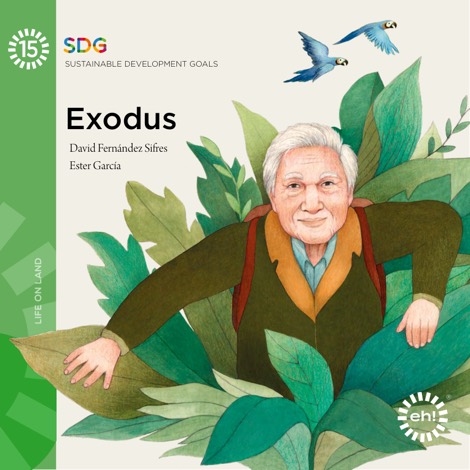
Exodus
Book 15 of 17 in the Eco Heroes SDG Library, one illustrated story for each UN Sustainable Development Goal. Included with any Eco Heroes plan (families from €79 a year + VAT: €95.59 with 21% Spanish VAT; the VAT and the total that apply to you are shown before you pay); SDG 1 is free to try. Published in English, Spanish, French, German, Italian, Portuguese, Catalan, Danish, Dutch, Japanese, Korean and Chinese.
Bring it into the room
Talk about it, try it
One question to ask after reading
“Which wild animal or plant near where you live would you most hate to lose? What does it need to survive?”
Ten-square-metre safari
Mark out a small patch of grass, park or schoolyard and count every living thing you can find in 15 minutes. Compare patches: which is richest, and why?
Watch
The short mission video
April and Karim walk through this goal in a short video, with subtitles in your language.
Transcript
Everything said in the video, in order, with the words and figures shown on screen.
Version for ages 9–12
- April: Forests, soil and every species. An Eco Heroes mission.
- On screen: An Eco Heroes mission · Goal 15 · ages 9–12
- On screen: See something real
- April: Nature is everywhere, even in a crack in the pavement. What happens to the animals when a forest disappears?
- On screen: A real question is where every mission starts.
- On screen: Investigate the system
- Karim: Life on Land is a system, not a headline.
- On screen: 10M ha of forest are lost every year — an area the size of a country. (Source: FAO, 2020)
- On screen: 1M species are threatened with extinction, many within decades. (Source: IPBES, 2019)
- On screen: ½ of the world's habitable land is used for farming, squeezing wild nature. (Source: FAO, 2023)
- On screen: Step 4 · Meet someone who understands it
- Karim: 10 million ha of forest are lost every year — an area the size of a country. 1 million species are threatened with extinction, many within decades. Ask the people who know: a park ranger, a beekeeper, a gardener.
- April: Your mission — Backyard Biologist. Discover the wild life on your doorstep. Do: Find and record 10 living things near you.
- On screen: Prove: Draw or photograph 3 of them.
- On screen: Reflect: Which depends on which?
- April: Bring it to school.
- On screen: Bring it to school: Show your class what you found. One finding from each of you becomes a map of your town.
- April: Show your class what you found. Discuss it at home.
- On screen: Discuss it at home: Tell your family what you did and ask them one question about it. Information fades — questions travel.
- April: Tell your family what you did and ask them one question about it. Take action locally.
- On screen: Take action locally: Pick the one action from your mission you can do this week — and tell one person why.
- Karim: A true story — The Woman Who Planted Trees. It's the little things citizens do.
- On screen: Small hands. Real problem. Real change.
- Karim: That's what will make the difference. Wangari Maathai. 17 goals, 13 languages, one hero: your child. eco-heroes.org
- On screen: eco-heroes.org/game
Version for ages 13–17
- April: Wild nature is shrinking.
- On screen: An Eco Heroes mission · Goal 15 · ages 13–17
- On screen: Notice something real
- April: It doesn't have to. Monitored wildlife populations have shrunk by 73% on average since 1970. What happens to a whole ecosystem when one species disappears?
- On screen: Hard questions are where real missions start.
- On screen: Map the system
- Karim: Nature is a system: forests, soil, farming, trade and what we eat. Every year about 10.9 million hectares of forest are cut down and turned to other
- On screen: 10.9M hectares of forest are cut down every year. (Source: FAO, 2025)
- On screen: 48,646 species are threatened with extinction. (Source: IUCN Red List, 2025)
- On screen: 73% average drop in wildlife populations since 1970. (Source: WWF, 2026)
- On screen: Step 4 · Talk to someone who knows
- Karim: uses. Interview someone who knows: a park ranger, an ecologist, a farmer.
- April: Your mission — Biodiversity Survey. Count the life in one patch of your neighbourhood.
- On screen: Do: Mark out one square metre and log every plant, insect and bird for a week.
- On screen: Prove: Compare a wild patch with a mown or paved one.
- On screen: Reflect: What would bring more life back here?
- April: Take it to school.
- On screen: Take it home: Ask your family what nature they remember from their childhood.
- On screen: Act where you live: Upload your sightings to a citizen-science app or join a planting day.
- On screen: Real data. Real questions. Real change.
- April: Share your data and propose a wild corner for your school grounds. Then take it home, and act where you live.
- Karim: A true story. It's the little things citizens do. That's what will make the difference. Wangari Maathai. 17 goals, 13 languages, your move. eco-heroes.org
China's Loess Plateau restoration miracle
In the Loess Plateau in China, one of the world's most eroded landscapes was restored through terracing, tree planting and community farming changes. Within 15 years, a barren plateau became green — lifting 2.5 million people out of poverty.
Quick check
Test yourself
What is biodiversity?Show the answer
- A type of diet
- The variety of all living things and ecosystems on Earth
- A rainforest only
- An organic farming method
Answer: The variety of all living things and ecosystems on Earth — Biodiversity refers to the variety of all living things — genes, species and ecosystems — that form the web of life on Earth.
The current rate of species extinction is estimated to be 1,000 times higher than natural background rates.Show the answer
Answer: True — We are in the sixth mass extinction — species are disappearing 1,000x faster than natural processes, primarily due to habitat loss.
What is deforestation?Show the answer
- Planting more trees
- Large-scale clearing of forests without adequate replanting
- A forest festival
- Cleaning up parks
Answer: Large-scale clearing of forests without adequate replanting — Deforestation is the large-scale removal of forests — it drives biodiversity loss, climate change and soil erosion.
Go further
Seventeen goals, seventeen stories
Every SDG gets its own illustrated book, its own facts and its own activities. SDG 1 is free to try: its game chapter, trivia and video. The books and the other goals unlock with a family, school or hotel plan.
See plans →