
Reading guide · Goal 15 · Life on Land
Exodus
Ages 6 to 14
A free reading guide for families and teachers: questions by age, vocabulary and activities.
About the story
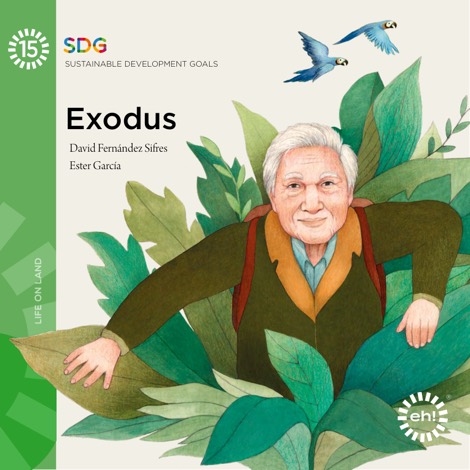
After a long day at a wildlife park full of ferrets, giraffes, tigers and vultures, Abril settles on the sofa with her dinner tray. Her father only lets her watch TV while eating if she picks a documentary, so she chooses one and is amazed by the presenter, who must be older than Grandma. Her father explains that he is David Attenborough, a legend. Holding up a fossilised Tyrannosaurus rex bone, Attenborough asks what story our own fossils would tell if humans disappeared. Then the documentary takes off into space. Aboard the spacecraft EXODUS, two robots wake up: Davidatt 1, a veteran explorer and science communicator, and Mikegunt 3, who specialises in holographic recordings. After twelve hundred cycles they are about to land on a planet they call THREE, the third from its sun, covered 70 per cent by water and home to more than eight million species. But the old probe data also showed forests in decline. What will the robots find when the hatch opens? The story is inspired by Sir David Attenborough.
Themes to talk about
- Forests and the millions of species that live in them
- Extinction, past and present
- Seeing our planet through a stranger's eyes
- Science communication and nature documentaries
- Sir David Attenborough
Questions to discuss
Ages 6 to 8
- Which animals did Abril see at the wildlife park? Which would you most like to see?
- Who are Davidatt 1 and Mikegunt 3? What job does each of them do?
- What name do the robots give to the planet they are visiting? Why?
- Why do you think the robots were made to look like the planet's cleverest species?
Ages 9 to 11
- David Attenborough asks, 'what story would our fossilised remains tell about us?' What do you think they would say?
- Davidatt 1 says forests cover 30 per cent of the land but are home to 80 per cent of its species. Why would losing forests be so serious?
- Mikegunt 3 imagines the most intelligent species must have solved the forest problem. Why might being clever not be enough?
- Abril's father says we share the planet with millions of species even if we do not always see them. Which living things do you share your street with?
Ages 12 to 14
- The probe data lists habitat loss, unregulated hunting and trafficking of species as problems caused by humans. Choose one and explain how it harms life on land.
- Why do you think the author tells this story through robots from another planet rather than through humans?
- At first Abril thinks the documentary is boring and the presenter is just old. How does her view of it change? What makes a documentary convincing?
- Research seed banks, such as the Svalbard Global Seed Vault: what are they, and why are they kept?
Words to learn
- species
- A group of living things that are alike and can breed together, such as tigers or oak trees.
- fossil
- The remains or shape of a plant or animal from long ago, preserved in rock.
- extinction
- When a species dies out completely and no living members are left.
- meteorite
- A rock from space that crashes into a planet's surface.
- habitat
- The natural home of a plant or animal.
- biodiversity
- The variety of all living things in a place or on the whole planet.
- hologram
- A three-dimensional image made with light.
- probe
- A spacecraft with no crew, sent to explore and collect information.
- deforestation
- Cutting down forests and not replacing them.
Activities
25 minutes
Our planet's file
Materials
- Paper and pencils
- Books or websites about Earth's habitats, with an adult
Steps
- Imagine you are Davidatt 1 preparing a file about THREE before landing.
- Write five facts about the planet: its water, its forests, its animals, its dominant species.
- Add one warning sign, as the probe found forests in decline.
- Read your file aloud in a robot voice and discuss what you would hope to find on landing.
30 minutes
Fossil of the future
Materials
- Modelling clay or salt dough
- Small everyday objects: a bottle top, a leaf, a key, a shell
Steps
- Press objects into the clay to make 'fossils'.
- Swap fossils with another group and try to work out what each object was and what it says about how we live.
- Answer Attenborough's question together: what story would our remains tell about us?
- Make one fossil of something you would like future explorers to find instead.
30 minutes
One patch, many species
Materials
- Four sticks and string to mark a square metre
- A magnifying glass
- Paper and pencil
Steps
- Outdoors, with an adult, mark a square metre of grass, soil or hedge.
- Count and draw every kind of plant and creature you find in it.
- Compare your count with the eight million species the robots read about.
- Talk about what would happen to your patch if it were paved over, and what could make it richer.
The link with SDG 15
Goal 15 aims to protect, restore and promote the sustainable use of land ecosystems, halt deforestation and stop the loss of biodiversity, and Target 15.5 calls for urgent action to protect threatened species and prevent their extinction. Exodus asks children to look at Earth as two robot explorers do, a planet of eight million species whose forests were already shrinking, and to wonder what our fossils will say about us.
All about SDG 15: Life on Land →Frequently asked questions
What age is Exodus for?
This guide offers questions for three age bands: 6 to 8, 9 to 11 and 12 to 14. Younger children enjoy the robots and the space journey; older readers can discuss extinction, deforestation and seed banks.
Which Sustainable Development Goal does Exodus cover?
It covers Goal 15, Life on Land, through a story inspired by Sir David Attenborough, in which two robot explorers travel to a distant planet full of forests and species.
Where can we read Exodus?
The full book is in the Eco Heroes library, available to members with a family or school plan. This reading guide is public and can be used by anyone at home or in class.
Read the whole book
“Exodus” is in the Eco Heroes library for members with a family or school plan. This guide is public: use it freely at home or in class.