
Reading guide · Goal 14 · Life Below Water
Glasses to Another World
Ages 6 to 14
A free reading guide for families and teachers: questions by age, vocabulary and activities.
About the story
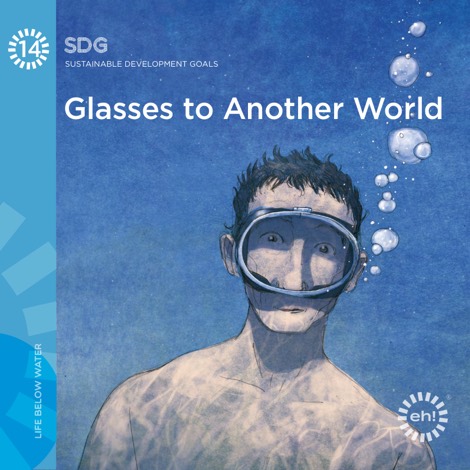
For Abril, holidays mean the beach with her grandparents, as surely as Sundays mean macaroni. Her grandmother loves the sea, and sometimes she does things there that make Abril want to disappear: wading in with her cane to fish out a plastic bag, or telling a tourist with a bucket of tiny fish that she has caught enough. This year, while Abril is lying on her towel scrolling through her phone, her grandmother takes the phone in exchange for an old pair of diving goggles, the most precious thing she owns, and gives her three rules for the sea. Then the story dives back in time to Jacques Cousteau, a young officer on the French Navy battleship Condorcet. His friend Philippe Tailliez offers him the first underwater goggles with space for the nose, and beneath the surface Jacques finds a world beyond anything he imagined. But one day an unknown fishing boat appears where no one ever fishes with nets. What will the two friends find in the posidonia? The story is inspired by Jacques-Yves Cousteau.
Themes to talk about
- Loving the sea and wanting to protect it
- Rules that protect sea creatures and their homes
- Plastic, overfishing and illegal nets
- Grandparents passing on what they love
- Jacques-Yves Cousteau and underwater exploration
Questions to discuss
Ages 6 to 8
- What does Abril's grandmother fish out of the sea with her cane?
- What does her grandmother give Abril in exchange for her phone?
- What sea creatures does Jacques see the first time he puts his head under the water?
- What is the first of the grandmother's three rules? Why does it matter?
Ages 9 to 11
- The grandmother tells the woman fishing from the breakwater that she has caught enough. Why does she care so much about a bucket of small fish?
- The grandmother says, 'The sea doesn't need rules, Abril. The sea is perfect.' Then who are the rules for?
- Abril wishes for a little house among the dunes, but her grandmother says the place is best left as it was a hundred years ago. Who do you agree with?
- Why is the net among the posidonia such a shock to Jacques and Philippe?
Ages 12 to 14
- The local fishermen have an unspoken agreement never to fish with nets in that area. Why might they have made it, and what does it tell you about people who depend on the sea?
- Jacques and Philippe hesitate before helping the trapped creature. What risks do they weigh up? What would you have done?
- Abril starts the story embarrassed by her grandmother. How do the goggles change the way she sees her grandmother and the sea?
- Research posidonia seagrass meadows in the Mediterranean: why do they matter for fish, for the water and for the climate?
Words to learn
- diving goggles
- Glasses that seal around the eyes so you can see clearly underwater.
- algae
- Simple plants without roots that grow in water, such as seaweed.
- molluscs
- Soft-bodied sea animals, often with a shell, such as mussels, snails and octopuses.
- breakwater
- A wall built out into the sea to protect a harbour or beach from waves.
- licence
- An official permit that allows you to do something, such as fish.
- dunes
- Hills of sand piled up by the wind near the sea.
- posidonia
- A seagrass that grows in underwater meadows in the Mediterranean, home to many fish.
- moray eel
- A long, snake-like fish that hides in rocky holes on the seabed.
- overfishing
- Catching fish faster than they can breed, until there are too few left.
Activities
20 minutes
Grandma's three rules
Materials
- Paper and coloured pencils
Steps
- Write down the grandmother's three rules for the sea in your own words.
- Draw a picture for each rule showing what it looks like on a real beach.
- Add a fourth rule of your own that would help protect the sea.
- Make a poster of all four rules to take on your next trip to the coast or a river.
25 minutes
The plastic bag journey
Materials
- A clean plastic bag
- A bowl of water
- Paper and pencil
Steps
- Drop the bag into the water and watch how it floats and moves. What might a turtle or fish think it is?
- Draw the journey a bag could take from a shop to the sea.
- List three places on that journey where someone could stop it, like the grandmother with her cane.
- Count the plastic bags in your home and agree on a plan to use fewer.
30 minutes
Look beneath the surface
Materials
- A clear plastic tub or jar
- A shallow pond, rock pool or bowl of water with stones and leaves, with an adult
Steps
- With an adult, press the bottom of the tub just under the surface of the water to make a simple underwater viewer.
- Look through it slowly, as Jacques does with his goggles. Note every living thing you see.
- Follow the rules: do not disturb the animals and take nothing away.
- Draw what you saw and compare it with what you could see from above.
The link with SDG 14
Goal 14 aims to conserve and sustainably use the oceans, seas and marine resources, and Target 14.1 calls for reducing marine pollution, including plastic, while Target 14.4 asks for an end to overfishing and illegal fishing. Glasses to Another World shows both: a grandmother pulling a plastic bag out of the waves, a bucket of fish too small to keep, and a net laid where nobody is supposed to fish.
All about SDG 14: Life Below Water →Frequently asked questions
What age is Glasses to Another World for?
This guide offers questions for three age bands: 6 to 8, 9 to 11 and 12 to 14. Younger children enjoy the underwater adventure; older readers can discuss overfishing, protected areas and marine pollution.
Which Sustainable Development Goal does Glasses to Another World cover?
It covers Goal 14, Life Below Water, through a story inspired by Jacques-Yves Cousteau, the French explorer who opened the underwater world to millions of people and worked to protect it.
Where can we read Glasses to Another World?
The full book is in the Eco Heroes library, available to members with a family or school plan. This reading guide is public and can be used by anyone at home or in class.
Read the whole book
“Glasses to Another World” is in the Eco Heroes library for members with a family or school plan. This guide is public: use it freely at home or in class.