
Reading guide · Goal 12 · Responsible Consumption
A Chicken Thigh
Ages 6 to 14
A free reading guide for families and teachers: questions by age, vocabulary and activities.
About the story
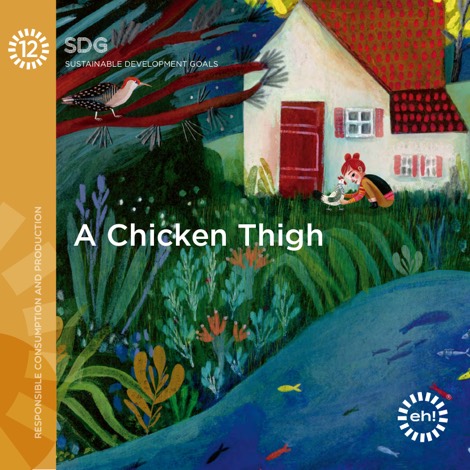
On a summer trip to India with her father, Abril rides an elephant through the forests of the Yamuna River, holding tight to Vivaan, the mahout who guides it with a small bamboo stick. Riding beside her is an elderly Swedish woman with untidy white hair like a lion's mane. Then the story travels back many years to Marilyn, a girl from London who loves difficult things, big things and, above all, imagining. Marilyn is staying with Grandma Dorothy, who lives on the edge of a tiny village with a vegetable garden and animals roaming the land, and around whom strange things always seem to happen. One lunchtime Marilyn leaves a bit of chicken thigh on her plate. It is so little, she protests; nothing will happen. Moments later the neighbour, Mr Collins, knocks at the door with a chicken that is not theirs, and the meadow behind the house begins to fill with animals that should not be there. What does a scrap of food have to do with it? The story is inspired by Marilyn Mehlmann.
Themes to talk about
- Food waste and respect for what we eat
- Small everyday choices that add up
- Animals, trees and resources used for nothing
- Grandparents, imagination and a little magic
- Marilyn Mehlmann and responsible consumption
Questions to discuss
Ages 6 to 8
- What animal does Abril ride in India? What is the man who guides it called?
- Why does Marilyn not want to finish her chicken thigh?
- Who knocks at the door with a chicken under his arm?
- What animals and plants start appearing in Grandma Dorothy's garden? Which would you most like to see?
Ages 9 to 11
- Grandma Dorothy says, 'That chicken can't have died for nothing, Marilyn.' What does she mean?
- Dorothy puts her own thigh next to Marilyn's and says it takes others leaving pieces to make a whole chicken. How can lots of small leftovers add up to something big?
- Grandma Dorothy thinks the animals that died needlessly have to go somewhere. Where does the food we throw away really go?
- Marilyn cries that it does not matter what she does. Her grandmother says it does. Who do you agree with?
Ages 12 to 14
- Vivaan says the elephant will go where he tells it to. How does that connect with what Marilyn learns at her grandmother's house?
- The trees that shoot up in the garden may be the trees that should not have been cut down. What else is wasted when food is wasted: land, water, energy?
- The story is part magic and part real. Why might a magical story make a point about waste more powerfully than facts alone?
- Research how much food is thrown away in homes in your country each year, and which foods are wasted most.
Words to learn
- mahout
- A person who rides, guides and looks after an elephant.
- pachyderm
- A large animal with thick skin, such as an elephant.
- reserve
- A protected area where wild animals and plants are looked after.
- chicken coop
- A small hut or cage where hens and chickens live.
- meadow
- A field of grass and wild flowers.
- needlessly
- For no good reason; when it could have been avoided.
- cacophony
- A loud, jumbled mixture of unpleasant sounds.
- food waste
- Food that is thrown away even though it could have been eaten.
- consumption
- How much of something, such as food, energy or things, people use up.
Activities
15 minutes
The leftovers diary
Materials
- A notebook
- A pencil
Steps
- For one week, write down any food left on plates at home after each meal.
- Note why it was left: too much served, did not like it, full, forgot it in the fridge.
- At the end of the week, add it all up. Would it make a whole meal, the way Dorothy's thighs make a chicken?
- Agree on one change, such as smaller first helpings, that would cut the leftovers.
25 minutes
What one thigh needs
Materials
- A large sheet of paper
- Coloured pencils
Steps
- Draw a chicken thigh in the middle of the page.
- Around it, draw everything that was needed to produce it: the chicken, its feed, the fields, water, energy, transport, the shop.
- Compare your drawing with the animals, trees and pond that appear in Grandma Dorothy's garden.
- Talk about what is lost when that thigh ends up in the bin.
30 minutes
Leftover makeover
Materials
- A few leftovers from the fridge, with an adult
- A recipe book or website
Steps
- With an adult, check the fridge for food that needs using up.
- Find or invent a recipe that turns those leftovers into a new dish.
- Plan who cooks, with an adult in charge of knives and heat.
- Share the dish and give it a name inspired by the story.
The link with SDG 12
Goal 12 aims to ensure sustainable consumption and production, and Target 12.3 calls for halving food waste per person in shops and homes and reducing food losses along production and supply chains. A Chicken Thigh turns that target into a single plate: one small leftover that Marilyn thinks does not matter, and a garden that fills with the animals, trees and fish used up for nothing.
All about SDG 12: Responsible Consumption →Frequently asked questions
What age is A Chicken Thigh for?
This guide offers questions for three age bands: 6 to 8, 9 to 11 and 12 to 14. Younger children enjoy the magic in Grandma Dorothy's garden; older readers can link it to real figures on food waste.
Which Sustainable Development Goal does A Chicken Thigh cover?
It covers Goal 12, Responsible Consumption and Production, through a story inspired by Marilyn Mehlmann, who has spent her life helping people see how everyday choices affect the planet.
Where can we read A Chicken Thigh?
The full book is in the Eco Heroes library, available to members with a family or school plan. This reading guide is public and can be used by anyone at home or in class.
Read the whole book
“A Chicken Thigh” is in the Eco Heroes library for members with a family or school plan. This guide is public: use it freely at home or in class.