
SDG 4 · Quality Education
273 million children and young people aren't in school.
Eco Heroes turns that fact into a story a 9-year-old can hold onto: The Children's House, book 4 of 17 in the SDG Library.
The target, in plain language
What the UN actually promised
By 2030, ensure that all girls and boys complete free, equitable and quality primary and secondary education leading to relevant and effective learning outcomes.
Target 4.7 asks that every learner gains the knowledge and skills to promote sustainable development. That's exactly what this library is for.
Why it matters
The number behind the story
Source: The Sustainable Development Goals Report 2026, UN DESA. Figures as published in July 2026.
The story
The Children's House
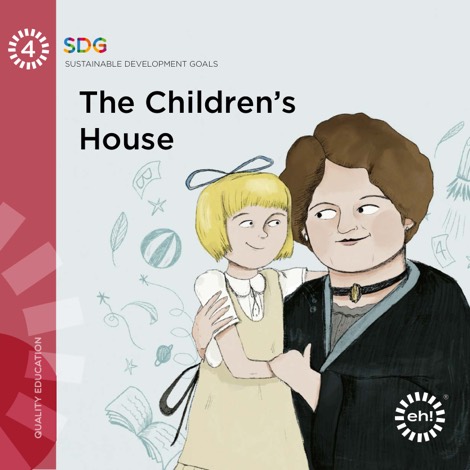
The Children's House
Book 4 of 17 in the Eco Heroes SDG Library, one illustrated story for each UN Sustainable Development Goal. Included with any Eco Heroes plan (families from €79 a year + VAT: €95.59 with 21% Spanish VAT; the VAT and the total that apply to you are shown before you pay); SDG 1 is free to try. Published in English, Spanish, French, German, Italian, Portuguese, Catalan, Danish, Dutch, Japanese, Korean and Chinese.
Bring it into the room
Talk about it, try it
One question to ask after reading
“If you couldn't go to school tomorrow, what would you miss first? And what could you still learn on your own?”
Teach someone something
Everyone picks a small skill they already have (a card trick, a word in another language, a way of drawing a cat) and teaches it to a partner. Afterwards, talk about what made the teaching work.
Watch
The short mission video
April and Karim walk through this goal in a short video, with subtitles in your language.
Transcript
Everything said in the video, in order, with the words and figures shown on screen.
Version for ages 9–12
- April: Every mind, a chance to grow. An Eco Heroes mission.
- On screen: An Eco Heroes mission · Goal 4 · ages 9–12
- On screen: See something real
- April: Teaching is the best way to truly learn. Why can't every child go to school?
- On screen: A real question is where every mission starts.
- On screen: Investigate the system
- Karim: Quality Education is a system, not a headline.
- On screen: 250M children and youth are out of school worldwide. (Source: UNESCO, 2023)
- Karim: 250 million children and youth are out of school worldwide. ten-year-olds in low-income countries can't read a simple text.
- On screen: 7 / 10 ten-year-olds in low-income countries can't read a simple text. (Source: World Bank, 2022)
- On screen: 763M adults still cannot read or write — most of them women. (Source: UNESCO, 2023)
- On screen: Step 4 · Meet someone who understands it
- Karim: Ask the people who know: a librarian, a teacher from another school, your grandparents.
- April: Your mission — Teach Someone. You already know things worth passing on. Share one. Do: Teach a younger child or family member something you know well.
- On screen: Prove: Write down what happened and what they learned.
- On screen: Reflect: What was hard about explaining it?
- April: Bring it to school.
- On screen: Bring it to school: Show your class what you found. One finding from each of you becomes a map of your town.
- April: Show your class what you found. Discuss it at home.
- On screen: Discuss it at home: Tell your family what you did and ask them one question about it. Information fades — questions travel.
- April: Tell your family what you did and ask them one question about it. Take action locally.
- On screen: Take action locally: Pick the one action from your mission you can do this week — and tell one person why.
- Karim: A true story — The Girl Who Stood for School. One child, one teacher, one book, one pen can change the world.
- On screen: Small hands. Real problem. Real change.
- Karim: Malala Yousafzai. 17 goals, 13 languages, one hero: your child. eco-heroes.org
- On screen: eco-heroes.org/game
Version for ages 13–17
- April: School changes lives.
- On screen: An Eco Heroes mission · Goal 4 · ages 13–17
- On screen: Notice something real
- April: Not everyone gets it. 273 million children and young people are out of school — and the number is rising. If education is a right, why can't every child learn?
- On screen: Hard questions are where real missions start.
- On screen: Map the system
- Karim: Education is a system: teachers, money, safety, language and time. 273 million children and young people were out of school in 2024.
- On screen: 273M children and young people are out of school. (Source: UNESCO GEM, 2026)
- On screen: 739M adults still can't read or write. (Source: UNESCO UIS, 2025)
- On screen: 4 in 10 children finish primary without basic reading. (Source: UNESCO GEM, 2026)
- On screen: Step 4 · Talk to someone who knows
- Karim: Interview someone who knows: a teacher, a librarian, a student who grew up in another country.
- April: Your mission — Learning Barriers. Find out what stops students learning — in your school and beyond.
- On screen: Do: Run an anonymous survey: what makes learning hard here?
- On screen: Prove: Rank the top three barriers using your data.
- On screen: Reflect: Which barrier would a school in a poorer country face too?
- April: Take it to school.
- On screen: Take it home: Ask your family what school was like for them.
- On screen: Act where you live: Tutor a younger student or support a book drive.
- On screen: Real data. Real questions. Real change.
- April: Present the top barrier to your head teacher with one fix. Then take it home, and act where you live.
- Karim: A true story. One child, one teacher, one book, one pen can change the world. Malala Yousafzai. 17 goals, 13 languages, your move. eco-heroes.org
Finland's education revolution
In Finland, education transformed from rote learning to creative problem-solving. Teachers are trusted professionals, students have minimal homework, and Finland consistently ranks in the world's top 5 for learning outcomes.
Quick check
Test yourself
How many children are out of school globally?Show the answer
- Thousands
- Millions
- 244 million
- Just a few
Answer: 244 million — 244 million children and youth worldwide still lack access to quality education.
Digital literacy is now considered a basic skill for the 21st century.Show the answer
Answer: True — Digital literacy is fundamental for employment and civic engagement in today's world.
What does inclusive education mean?Show the answer
- Only top students
- Education for everyone regardless of ability
- Only for boys
- Online only
Answer: Education for everyone regardless of ability — Inclusive education ensures all learners — including those with disabilities — can access quality learning.
Go further
Seventeen goals, seventeen stories
Every SDG gets its own illustrated book, its own facts and its own activities. SDG 1 is free to try: its game chapter, trivia and video. The books and the other goals unlock with a family, school or hotel plan.
See plans →