
Reading guide · Goal 4 · Quality Education
The Children's House
Ages 6 to 14
A free reading guide for families and teachers: questions by age, vocabulary and activities.
About the story
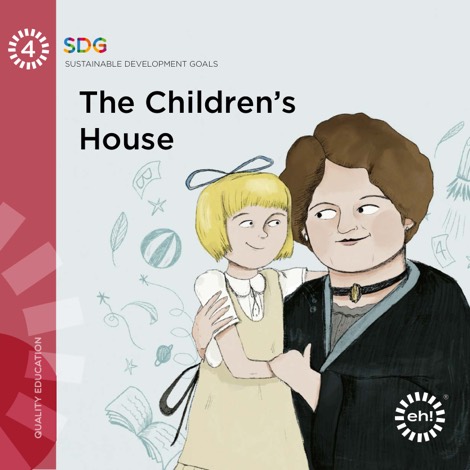
Abril, eyes closed in her secret hideaway, wonders what she will be when she grows up and knows only that she wants to work with children, just like the heroine of the story she imagines. Maria, a brave and determined young woman, has been asked to open a home where children aged three to six can learn and be safe from the dangers of the street while their parents are out at work. She is too busy to say yes, until curiosity takes her to San Lorenzo, one of the poorest neighbourhoods in Rome. There she sees a girl chasing smaller children with a stick, a filthy building with no front door and a little boy crying on the floor who calls her a witch. Maria gathers a mason, an electrician, a painter and a team of helpers, and The Children's House opens its doors. But how do you teach children who are hungry, frightened and ready to run? The story is inspired by Maria Montessori and her Casa dei Bambini.
Themes to talk about
- Education as a way out of poverty
- Children who learn at their own pace
- Safety, food and trust before letters and numbers
- Respect for yourself, for others and for the place you live
- Maria Montessori and La Casa dei Bambini
Questions to discuss
Ages 6 to 8
- What does the girl carry with her on the first day at The Children's House? Why does she not want to let it go?
- What surprise does Maria take out of the cupboard for the children?
- How does Maria get the children laughing together when they cannot remember her name?
- Which three rules does Maria say are not allowed in the house? Do you have the same rules?
Ages 9 to 11
- Maria thinks children cannot learn letters or listen to a story on an empty stomach. Why does food come before lessons?
- Some of the children are bullies and some are afraid of being hit. How does Maria start to build trust between them?
- Maria visits the parents before the house opens. Why is it important to convince them?
- Why do you think the number of children doubles the following week?
Ages 12 to 14
- Standing outside the old building, Maria thinks, 'It's not their fault they were born into poverty.' How can school change the future that awaits these children?
- At The Children's House each child advances at their own pace. What are the advantages of that, and what might be hard about it?
- The children learn cleaning habits, manual tasks and respect for animals and plants as well as reading and writing. Why might these matter as much as the lessons?
- Research the Montessori method: which of its ideas can you still see in schools today?
Words to learn
- illiterate
- Not able to read or write.
- neighbourhood
- A part of a town or city where people live close together.
- premonition
- A strong feeling that something is about to happen.
- dilapidated
- Old, broken and badly looked after.
- mason
- A builder who works with stone or brick.
- inaugurate
- To open something new officially for the first time.
- incorrigible
- Impossible to change, usually said with a smile about a habit.
- pedagogy
- The study of how people learn and how best to teach them.
- Rome
- The capital city of Italy, where the story is set.
Activities
15 minutes
The name game
Materials
- Nothing but a space to move around in
Steps
- Sit in a circle and say your names one by one, as Maria asks the children to do.
- The leader asks who remembers their name and pretends it has run away.
- Everyone hunts for the name on hands and knees, as the children do in the book, until someone finds it.
- Talk about why laughing together can make a new group feel safer.
30 minutes
Design a children's house
Materials
- A large sheet of paper
- Coloured pencils
- A ruler
Steps
- Draw a floor plan of a home where young children can learn and feel safe.
- Add the things in the book: child-sized furniture, toys, a place to eat, a place to wash.
- Mark where children can choose what to do and where they can work at their own pace.
- Explain your plan to someone else and say which room you would most like to spend time in.
25 minutes
Learning by doing
Materials
- Simple everyday tasks: a cloth, a plant to water, a jug and cups, buttons to sort
Steps
- Set out the tasks on a table, like the cleaning and manual chores the children learn in the book.
- Each child chooses a task and does it slowly and carefully, without being rushed.
- Afterwards, ask: what did you learn? Did anyone need help, and who gave it?
- Talk about what is different when you choose your own task instead of being told what to do.
The link with SDG 4
Goal 4 aims to ensure inclusive, quality education for all, and Target 4.2 asks that every young child has access to good early childhood care and pre-primary education so they are ready for school. The Children's House shows what that means in San Lorenzo: children aged three to six who were left alone on the street get food, safety, respect and the chance to learn at their own pace.
All about SDG 4: Quality Education →Frequently asked questions
What age is The Children's House for?
This guide offers questions for three age bands: 6 to 8, 9 to 11 and 12 to 14. Younger children enjoy the name game and the chocolate cake; older readers can explore the Montessori method behind the story.
Which Sustainable Development Goal does The Children's House cover?
It covers Goal 4, Quality Education, through a story inspired by Maria Montessori, who opened a home for poor children in the San Lorenzo neighbourhood of Rome.
Where can we read The Children's House?
The full book is in the Eco Heroes library, available to members with a family or school plan. This reading guide is public and can be used by anyone at home or in class.
Read the whole book
“The Children's House” is in the Eco Heroes library for members with a family or school plan. This guide is public: use it freely at home or in class.