
SDG 2 · Zero Hunger
One in thirteen people on Earth doesn't get enough to eat.
Eco Heroes turns that fact into a story a 9-year-old can hold onto: The Banker to the Poor, book 2 of 17 in the SDG Library.
The target, in plain language
What the UN actually promised
By 2030, end hunger and ensure access by all people, in particular the poor and people in vulnerable situations, including infants, to safe, nutritious and sufficient food all year round.
Target 2.2 goes further: end all forms of malnutrition. Stunting in children under 5 has fallen from 26.4 to 23.2 per cent, which means 30.2 million fewer children affected. Still far from zero.
Why it matters
The number behind the story
Source: The Sustainable Development Goals Report 2026, UN DESA. Figures as published in July 2026.
The story
The Banker to the Poor
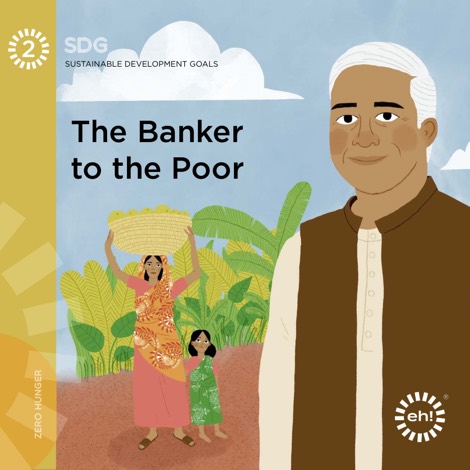
The Banker to the Poor
Book 2 of 17 in the Eco Heroes SDG Library, one illustrated story for each UN Sustainable Development Goal. Included with any Eco Heroes plan (families from €79 a year + VAT: €95.59 with 21% Spanish VAT; the VAT and the total that apply to you are shown before you pay); SDG 1 is free to try. Published in English, Spanish, French, German, Italian, Portuguese, Catalan, Danish, Dutch, Japanese, Korean and Chinese.
Bring it into the room
Talk about it, try it
One question to ask after reading
“Where did the last thing you ate come from, and how many people had to work so it could reach your plate?”
Trace one meal back to the field
Pick today's lunch, list every ingredient and guess where each one was grown. Then talk about what would happen to that meal if one link in the chain broke: a drought, a closed road, a sudden price rise.
Watch
The short mission video
April and Karim walk through this goal in a short video, with subtitles in your language.
Transcript
Everything said in the video, in order, with the words and figures shown on screen.
Version for ages 9–12
- April: End hunger. Feed the future. An Eco Heroes mission.
- On screen: An Eco Heroes mission · Goal 2 · ages 9–12
- On screen: See something real
- April: A single seed can feed a family for years. Why is food thrown away while people go hungry?
- On screen: A real question is where every mission starts.
- On screen: Investigate the system
- Karim: Zero Hunger is a system, not a headline. 733 million people face hunger every single day.
- On screen: 733 million people face hunger every single day. (Source: UN — State of Food Security & Nutrition, 2024)
- Karim: of all food produced is lost or thrown away.
- On screen: 1 / 3 of all food produced is lost or thrown away. (Source: UNEP Food Waste Index, 2024)
- On screen: 3.1B people cannot afford a healthy diet. (Source: FAO / SOFI, 2024)
- On screen: Step 4 · Meet someone who understands it
- Karim: Ask the people who know: a farmer, a school cook, a market seller.
- April: Your mission — The Seed-Grower. Real food starts small. Grow something with your own hands. Do: Plant a seed in a cup of soil.
- On screen: Do: Plant a seed in a cup of soil. Water it a little every day for one week.
- On screen: Prove: Photograph or draw your sprout each day.
- On screen: Reflect: What did your plant need — and who grows the food you eat?
- April: Bring it to school.
- On screen: Bring it to school: Show your class what you found. One finding from each of you becomes a map of your town.
- April: Show your class what you found. Discuss it at home.
- On screen: Discuss it at home: Tell your family what you did and ask them one question about it. Information fades — questions travel.
- April: Tell your family what you did and ask them one question about it. Take action locally.
- On screen: Take action locally: Pick the one action from your mission you can do this week — and tell one person why.
- Karim: A true story — The Man Who Fed a Billion. Food is the moral right of all who are born into this world.
- On screen: Small hands. Real problem. Real change.
- Karim: Norman Borlaug. 17 goals, 13 languages, one hero: your child. eco-heroes.org
- On screen: eco-heroes.org/game
Version for ages 13–17
- April: Enough food for everyone.
- On screen: An Eco Heroes mission · Goal 2 · ages 13–17
- On screen: Notice something real
- April: So why the hunger? Every day, households throw away more than a billion meals.
- On screen: Hard questions are where real missions start.
- On screen: Map the system
- April: The world grows enough food for everyone — so why do 645 million people go hungry?
- Karim: Food is a system: farms, prices, trade, waste and war. About 645 million people faced hunger in 2025, around 1 in 13 people on Earth.
- On screen: 645M people faced hunger in 2025. (Source: FAO SOFI, 2026)
- On screen: 2.69B people can't afford a healthy diet. (Source: FAO SOFI, 2026)
- On screen: 1B meals are wasted by households every day. (Source: UNEP, 2024)
- On screen: Step 4 · Talk to someone who knows
- Karim: Interview someone who knows: a farmer, a supermarket manager, a food-bank coordinator.
- April: Your mission — Waste Audit. Measure how much food your school throws away in a week.
- On screen: Do: Weigh the food left on plates in your canteen for five days.
- On screen: Prove: Turn it into meals and money wasted per year.
- On screen: Reflect: What one change would cut most of it?
- April: Take it to school.
- On screen: Take it home: Track your family's food waste for a week and compare.
- On screen: Act where you live: Connect your school or a local shop with a food-sharing scheme.
- On screen: Real data. Real questions. Real change.
- April: Share the numbers with your canteen staff and propose one fix. Then take it home, and act where you live.
- Karim: A true story. Food is the moral right of all who are born into this world. Norman Borlaug. 17 goals, 13 languages, your move. eco-heroes.org
Fighting hunger with community action
In Ethiopia, the Productive Safety Net Programme gave food or cash to 8 million people during droughts — not as charity, but in exchange for community work like building roads and planting trees.
Quick check
Test yourself
SDG 2 aims to achieve what about hunger?Show the answer
- Double it
- Ignore it
- End it
- Tax it
Answer: End it — SDG 2 aims to end hunger and achieve food security for all by 2030.
Which food choice is most sustainable?Show the answer
- Imported beef every day
- Local vegetables in season
- Packaged snacks
- Throwing food away
Answer: Local vegetables in season — Eating local seasonal vegetables reduces emissions and supports local farmers.
About one-third of all food produced globally is lost or wasted.Show the answer
Answer: True — Roughly 1.3 billion tonnes of food is wasted every year — enough to feed 3 billion people.
Go further
Seventeen goals, seventeen stories
Every SDG gets its own illustrated book, its own facts and its own activities. SDG 1 is free to try: its game chapter, trivia and video. The books and the other goals unlock with a family, school or hotel plan.
See plans →