
Reading guide · Goal 2 · Zero Hunger
The Banker to the Poor
Ages 6 to 14
A free reading guide for families and teachers: questions by age, vocabulary and activities.
About the story
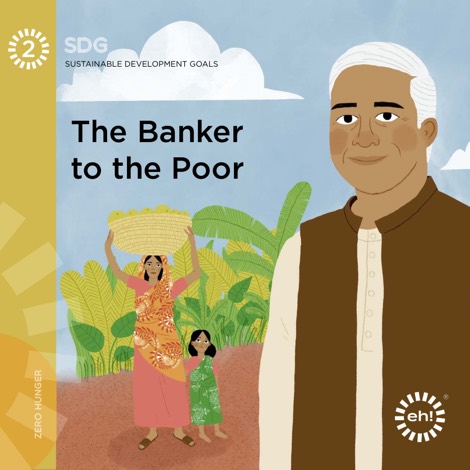
One weekend Abril has seen some images that sadden her, so she shuts her eyes in her secret hideaway and flies off to a slum in Bangladesh, the setting of this story inspired by Muhammad Yunus. Muhammad has only just moved there. In the market the stalls are nearly empty, the little food on sale is too expensive, and hunger shows in every thin face. When he sees a man shouting at Asha, a vegetable seller, he steps in. Asha explains that her produce comes from far away; if she could grow it nearby, food would be cheaper, but she has no money for seeds or land. Muhammad goes with her and her little daughter to ask a bank for a small loan, and the director turns them away. After a sleepless night and an early-morning jog, Muhammad has an idea, and Asha points out that she is far from the only woman who needs help. Will the men who laugh at him be proved right? The book ends with the real Muhammad Yunus and his microcredits.
Themes to talk about
- Hunger in a market with almost nothing on sale
- Trusting people that nobody else trusts
- Small loans and fair repayment
- Women working together so that everyone gets a turn
- Muhammad Yunus, the Banker to the Poor
Questions to discuss
Ages 6 to 8
- Why is the food in the market so expensive, and why does nobody buy it?
- How does Asha's little girl look at Muhammad when they leave the bank? What do you think she is asking him?
- What does Muhammad do on the morning he has his idea?
- The women look after each other's children and animals. How do people in your home or class help each other?
Ages 9 to 11
- Asha says the bank would never even let her in because she is poor and a woman. Why do you think the bank says no?
- Muhammad kneels down beside Asha and her daughter when he first talks to them. Why might that help her trust him?
- Asha says she could never earn money and buy food while others go hungry. What does that tell you about her?
- Why does Muhammad decide to lend to the women first? Do you agree with his reason?
Ages 12 to 14
- A vendor says, 'An empty stomach can make you say things you don't mean.' How can hunger change the way people treat each other?
- The men are sure Muhammad will never see his money again. What do the women do to make sure every loan is repaid?
- Growing food nearby instead of bringing it from far away makes it cheaper. What else changes in the slum when the stalls fill with fresh produce?
- Research microcredit: what is it, and what are its strengths and its risks for families living in poverty?
Words to learn
- slum
- A crowded part of a city where people live in poor, often unsafe housing.
- loan
- Money someone lends you that you agree to pay back later.
- debt
- Money that you owe and still have to pay back.
- deadline
- The last day by which something has to be done.
- profitable
- Making more money than it costs.
- produce
- Fruit and vegetables that have been grown to eat or sell.
- harvest
- Gathering in the crops when they are ready.
- microcredit
- A very small loan for people who cannot borrow from an ordinary bank.
- Bangladesh
- A country in South Asia, where Muhammad Yunus comes from and where the story is set.
Activities
25 minutes
Market stall maths
Materials
- Paper and pencils
- Counters, beans or buttons to stand for money
Steps
- Set up Asha's stall twice: once with produce brought from far away, once with produce grown nearby.
- Give each version a cost for seeds, transport and land, using counters. Which one lets Asha charge a lower price?
- Play a customer with ten counters. How much food can you buy at each stall?
- Talk about why cheaper food at the market matters to the children in the story.
30 minutes
The lending circle
Materials
- A pot of dried beans as pretend money
- Slips of paper with simple jobs: plant, feed the animals, look after the children
Steps
- One person is the lender and has enough beans for only half the group.
- Those who borrow do a job and give the beans back after three rounds; those still waiting help them by taking on one of the jobs.
- When the beans come back, the lender passes them to the next group.
- Talk about it: how did helping others pay back sooner change the game? Link it to what the women do in the book.
20 minutes
From far away or nearby?
Materials
- Five fruits or vegetables from your kitchen, or their labels
- A world map or atlas
Steps
- Find where each item was grown and mark it on the map.
- Sort them into grown near home and brought from far away.
- Discuss what transport adds to the price, as Asha explains to Muhammad.
- Plan one meal you could make from food grown closer to home.
The link with SDG 2
Goal 2 aims to end hunger and make sure everyone has enough safe, nutritious food all year round, and Target 2.3 asks for more income for small-scale food producers, especially women. The Banker to the Poor shows both in one market: once Asha and the other women can afford seeds, tools and land nearby, the stalls fill with fresh food at a fair price, the families earn more and the children stop crying from hunger.
All about SDG 2: Zero Hunger →Frequently asked questions
What age is The Banker to the Poor for?
This guide offers questions for three age bands: 6 to 8, 9 to 11 and 12 to 14. With younger children it works well as a shared read-aloud; older readers can go on to explore how microcredit works.
Which Sustainable Development Goal does The Banker to the Poor cover?
It covers Goal 2, Zero Hunger, through a story inspired by Muhammad Yunus: how small loans to women in a Bangladeshi slum fill an empty market with affordable food.
Where can we read The Banker to the Poor?
The full book is in the Eco Heroes library, available to members with a family or school plan. This reading guide is public and can be used by anyone at home or in class.
Read the whole book
“The Banker to the Poor” is in the Eco Heroes library for members with a family or school plan. This guide is public: use it freely at home or in class.