
🎬 short mission video
Every goal, explained in a short video — in your language.
SDG 6 · Clean Water and Sanitation
One in four people can't count on safe water at home.
Eco Heroes turns that fact into a story a 9-year-old can hold onto: The Water Man, book 6 of 17 in the SDG Library.
The target, in plain language
What the UN actually promised
By 2030, achieve universal and equitable access to safe and affordable drinking water for all.
Target 6.2 adds sanitation and hygiene for all, paying special attention to the needs of women and girls. In 2024, one in five people still had no basic place to wash their hands with soap and water.
Why it matters
The number behind the story
Source: The Sustainable Development Goals Report 2026, UN DESA. Figures as published in July 2026.
The story
The Water Man
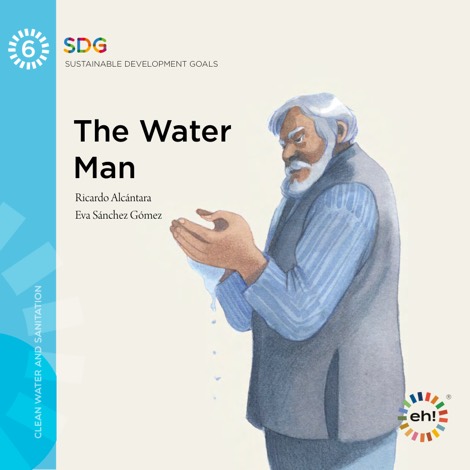
The Water Man
Book 6 of 17 in the Eco Heroes SDG Library, one illustrated story for each UN Sustainable Development Goal. Included with any Eco Heroes plan (families from €79 a year + VAT: €95.59 with 21% Spanish VAT; the VAT and the total that apply to you are shown before you pay); SDG 1 is free to try. Published in English, Spanish, French, German, Italian, Portuguese, Catalan, Danish, Dutch, Japanese, Korean and Chinese.
Bring it into the room
Talk about it, try it
One question to ask after reading
“How many times did you use water today before you even left the house?”
Keep a water diary
For one morning, list every time you use water and estimate the litres. Then imagine carrying all of it from a tap a kilometre away. Which uses would you drop first?
Watch
The short mission video
April and Karim walk through this goal in a short video, with subtitles in your language.
Transcript
Everything said in the video, in order, with the words and figures shown on screen.
Version for ages 9–12
- April: Clean water. For every hand. An Eco Heroes mission.
- On screen: An Eco Heroes mission · Goal 6 · ages 9–12
- On screen: See something real
- April: One drip per second wastes over 10,000 litres a year. Where does the water in our tap actually come from — and who keeps it clean?
- On screen: A real question is where every mission starts.
- On screen: Investigate the system
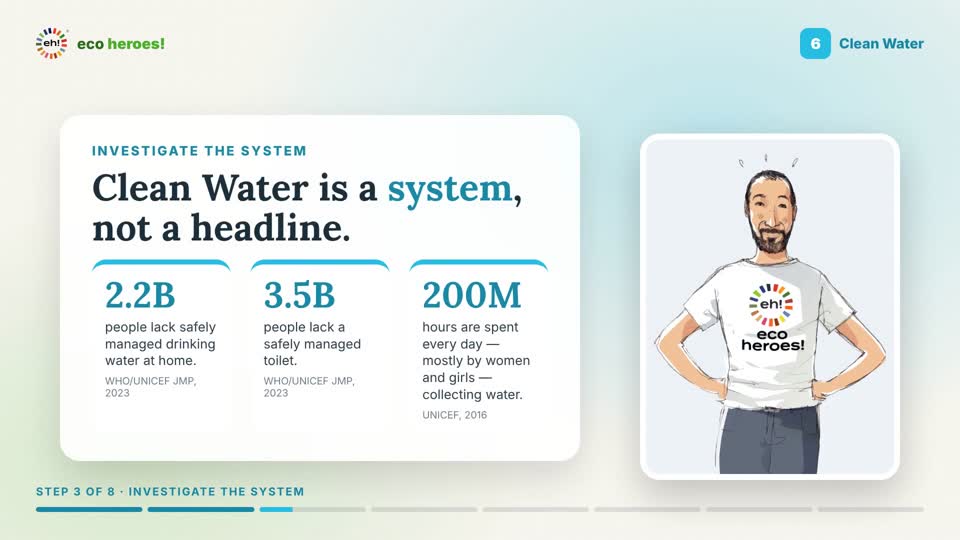
- On screen: 2.2B people lack safely managed drinking water at home. (Source: WHO/UNICEF JMP, 2023)
- On screen: 3.5B people lack a safely managed toilet. (Source: WHO/UNICEF JMP, 2023)
- On screen: 200M hours are spent every day — mostly by women and girls — collecting water. (Source: UNICEF, 2016)
- On screen: Step 4 · Meet someone who understands it
- Karim: Clean Water is a system, not a headline. 2.2 billion people lack safely managed drinking water at home. 3.5 billion people lack a safely managed toilet. Ask the people who know: a water-company technician, a plumber, a river-cleanup group.
- April: Your mission — The Leak Detective. A dripping tap can waste thousands of litres a year. Hunt them down. Do: Check every tap at home or school for drips.
- On screen: Do: Check every tap at home or school for drips. Count them.
- On screen: Prove: Report or fix the leaks — note how many you found.
- On screen: Reflect: Where else might water be quietly wasted?
- April: Bring it to school.
- On screen: Bring it to school: Show your class what you found. One finding from each of you becomes a map of your town.
- April: Show your class what you found. Discuss it at home.
- On screen: Discuss it at home: Tell your family what you did and ask them one question about it. Information fades — questions travel.
- April: Tell your family what you did and ask them one question about it. Take action locally.
- On screen: Take action locally: Pick the one action from your mission you can do this week — and tell one person why.
- Karim: A true story — The Girl Who Spoke for the Water. We can't eat money, or drink oil.
- On screen: Small hands. Real problem. Real change.
- Karim: Autumn Peltier. 17 goals, 13 languages, one hero: your child. eco-heroes.org
- On screen: eco-heroes.org/game
Version for ages 13–17
- April: Clean water is not a given.
- On screen: An Eco Heroes mission · Goal 6 · ages 13–17
- On screen: Notice something real
- April: 1 in 4 people on Earth still cannot count on safe drinking water at home. Water covers most of the planet — so why do 2.1 billion people lack safe water?
- On screen: Hard questions are where real missions start.
- On screen: Map the system
- Karim: Water is a system:
- On screen: 2.1B people lack safely managed drinking water at home. (Source: WHO/UNICEF, 2025)
- On screen: 106M people still drink untreated water from rivers, lakes and streams. (Source: WHO/UNICEF, 2025)
- On screen: 30min+ a day many women and girls spend just fetching water. (Source: WHO/UNICEF, 2025)
- On screen: Step 4 · Talk to someone who knows
- Karim: pipes, power, prices and politics. 2.1 billion people lack safely managed drinking water at home. Interview someone who knows: a water-treatment engineer, a hydrologist, a river-restoration group.
- April: Your mission — Follow the Water. Find out where your town's water comes from — and what it takes to clean it.
- On screen: Do: Trace your tap water back to its source using your water company's public reports.
- On screen: Prove: Map the route and mark one risk: pollution, drought or leaks.
- On screen: Reflect: Who pays when the system fails — and who decides?
- April: Take it to school.
- On screen: Take it home: Show your family the map and ask where they think your water comes from.
- On screen: Act where you live: Join a river clean-up or ask your water company one public question about leaks.
- On screen: Real data. Real questions. Real change.
- April: Share your map with your class and compare it with a place that lacks safe water. Then take it home, and act where you live.
- Karim: A true story. We can't eat money, or drink oil. Autumn Peltier. 17 goals, 13 languages, your move. eco-heroes.org
Singapore's water miracle
Singapore turned a water crisis into a water miracle. With no natural aquifers, they built a system of recycled water, desalination and rainwater collection — now exporting water technology worldwide.
Quick check
Test yourself
How much of Earth's water is drinkable?Show the answer
- 97%
- 50%
- Less than 3%
- 25%
Answer: Less than 3% — Less than 3% of Earth's water is fresh — and most of that is frozen in glaciers.
A leaking tap can waste up to 15,000 litres of water per year.Show the answer
Answer: True — Even a small drip from a leaking tap can waste enormous amounts — fixing leaks is one of the most impactful water actions.
What causes water stress?Show the answer
- Water is too cold
- Demand for water exceeds available supply
- There is too much rain
- Water tastes bad
Answer: Demand for water exceeds available supply — Water stress occurs when annual water supplies drop below 1,700 cubic metres per person.
Go further
Seventeen goals, seventeen stories
Every SDG gets its own illustrated book, its own facts and its own activities. SDG 1 is free to try: its game chapter, trivia and video. The books and the other goals unlock with a family, school or hotel plan.
See plans →