
SDG 7 · Affordable and Clean Energy
655 million people still live without electricity.
Eco Heroes turns that fact into a story a 9-year-old can hold onto: A Furrowed Brow, book 7 of 17 in the SDG Library.
The target, in plain language
What the UN actually promised
By 2030, ensure universal access to affordable, reliable and modern energy services.
Target 7.2 asks the world to substantially increase the share of renewable energy in the global energy mix.
Why it matters
The number behind the story
Source: The Sustainable Development Goals Report 2026, UN DESA. Figures as published in July 2026.
The story
A Furrowed Brow
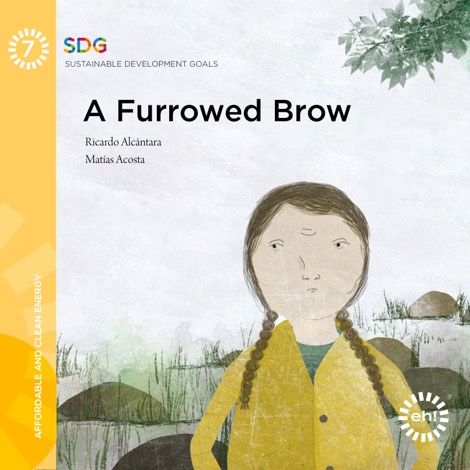
A Furrowed Brow
Book 7 of 17 in the Eco Heroes SDG Library, one illustrated story for each UN Sustainable Development Goal. Included with any Eco Heroes plan (families from €79 a year + VAT: €95.59 with 21% Spanish VAT; the VAT and the total that apply to you are shown before you pay); SDG 1 is free to try. Published in English, Spanish, French, German, Italian, Portuguese, Catalan, Danish, Dutch, Japanese, Korean and Chinese.
Bring it into the room
Talk about it, try it
One question to ask after reading
“What would you miss first in a home with no electricity after dark? And what would you do instead?”
Run a power audit
Walk around your home or classroom and list everything that's plugged in. Sort it into “need”, “nice to have” and “could switch off right now”, then switch one thing off together.
Watch
The short mission video
April and Karim walk through this goal in a short video, with subtitles in your language.
Transcript
Everything said in the video, in order, with the words and figures shown on screen.
Version for ages 9–12
- April: Power the world, without wrecking it. An Eco Heroes mission.
- On screen: An Eco Heroes mission · Goal 7 · ages 9–12
- On screen: See something real
- April: Devices on standby quietly sip power all day. Where does the electricity in this room come from?
- On screen: A real question is where every mission starts.
- On screen: Investigate the system
- Karim: Clean Energy is a system, not a headline.
- On screen: 685M people live with no access to electricity. (Source: IEA / World Bank, 2022)
- On screen: 2.3B people cook with polluting fuels that harm their health. (Source: WHO, 2023)
- On screen: #1 Solar and wind are now the cheapest source of new electricity in most countries. (Source: IEA, 2023)
- On screen: Step 4 · Meet someone who understands it
- Karim: 685 million people live with no access to electricity. 2.3 billion people cook with polluting fuels that harm their health. Ask the people who know: an electrician, someone with solar panels, your building's caretaker.
- April: Your mission — The Energy Hunter. Track down energy being wasted in your home. Do: Find 5 things left on or plugged in when not used.
- On screen: Prove: Switch them off and note which ones.
- On screen: Reflect: Which was easiest to change for good?
- April: Bring it to school.
- On screen: Bring it to school: Show your class what you found. One finding from each of you becomes a map of your town.
- April: Show your class what you found. Discuss it at home.
- On screen: Discuss it at home: Tell your family what you did and ask them one question about it. Information fades — questions travel.
- April: Tell your family what you did and ask them one question about it. Take action locally.
- On screen: Take action locally: Pick the one action from your mission you can do this week — and tell one person why.
- Karim: A true story — The Boy Who Harnessed the Wind. I try, and I made it.
- On screen: Small hands. Real problem. Real change.
- Karim: William Kamkwamba. 17 goals, 13 languages, one hero: your child. eco-heroes.org
- On screen: eco-heroes.org/game
Version for ages 13–17
- April: Clean power is cheaper.
- On screen: An Eco Heroes mission · Goal 7 · ages 13–17
- On screen: Notice something real
- April: So what's the hold-up? 91% of new renewable power projects are now cheaper than new fossil fuel options. If clean energy is cheaper, why do we still burn so much coal, oil and gas?
- On screen: Hard questions are where real missions start.
- On screen: Map the system
- Karim: Energy is a system: grids, money, jobs, habits and politics. 655 million people still live without electricity, almost 9 in 10 of them in Africa.
- On screen: 655M people live without electricity. (Source: Tracking SDG7, 2026)
- On screen: 2B people cook with polluting fuels. (Source: Tracking SDG7, 2026)
- On screen: 91% of new renewable projects beat fossil fuels on cost. (Source: IRENA, 2025)
- On screen: Step 4 · Talk to someone who knows
- Karim: Interview someone who knows: an electrician, an energy engineer, someone from a local energy co-op.
- April: Your mission — Energy Audit. Find where your school wastes energy — and what it costs.
- On screen: Do: Read the meters or bills and log what stays on after hours.
- On screen: Prove: Calculate the yearly cost of the waste.
- On screen: Reflect: Would solar panels pay off here — and who decides?
- April: Take it to school.
- On screen: Take it home: Find your home's biggest energy user and compare tariffs with your family.
- On screen: Act where you live: Ask your council about local solar or join an energy co-op campaign.
- On screen: Real data. Real questions. Real change.
- April: Present your audit to the student council with one costed fix. Then take it home, and act where you live.
- Karim: A true story. I try, and I made it. William Kamkwamba. 17 goals, 13 languages, your move. eco-heroes.org
Solar power reaches rural Kenya
In Kenya, off-grid solar has reached 2.3 million homes with no grid connection. Companies like M-KOPA allow payments by mobile phone — making solar affordable for the first time for rural families.
Quick check
Test yourself
Which is a renewable energy source?Show the answer
- Coal
- Oil
- Solar
- Gas
Answer: Solar — Solar energy is renewable — it comes from an inexhaustible source (the sun) and produces no emissions when generating power.
Fossil fuels currently provide about 80% of the world's energy.Show the answer
Answer: True — Despite rapid growth in renewables, fossil fuels still supply around 80% of global energy.
What is energy poverty?Show the answer
- Expensive energy bills
- Lack of access to modern, reliable energy services
- Using too much energy
- A type of renewable
Answer: Lack of access to modern, reliable energy services — Energy poverty affects 800 million people who have no access to electricity and 2.6 billion who cook with polluting fuels.
Go further
Seventeen goals, seventeen stories
Every SDG gets its own illustrated book, its own facts and its own activities. SDG 1 is free to try: its game chapter, trivia and video. The books and the other goals unlock with a family, school or hotel plan.
See plans →