
Reading guide · Goal 1 · No Poverty
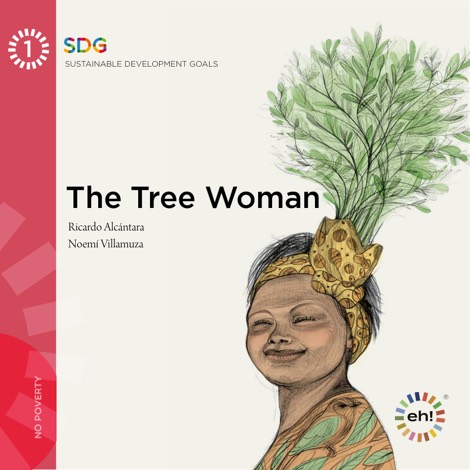
The Tree Woman
Ages 6 to 14
A free reading guide for families and teachers: questions by age, vocabulary and activities.
About the story
Abril, a girl who slips into her secret hideaway, closes her eyes and lets her imagination run wild, builds this story around Wangari Maathai. A woman steps off a bus at the edge of a Kenyan village where the trees have gone: the ground is dry and bare, the ponds are empty holes, the women walk further every day for firewood and water, and the children are skin and bones. Wangari will not stand by. She walks to the forest of the oldest trees, asks the earth for permission and digs up seven sprouts to plant in her garden. First the old woman across the road joins her, then the village women, who sew tents from rags to germinate seeds while the men mock them. Wangari then knocks on the door of the sawmill owner and the local authorities. Can a handful of sprouts change a whole village? The book closes with the real Wangari Maathai and the Green Belt Movement she founded.
Themes to talk about
- Planting today what will grow tomorrow
- Poverty you can see in the land, the water and the schools
- Women organising together and changing a village
- Persuading and negotiating, not just working hard
- Wangari Maathai and the Green Belt Movement
Questions to discuss
Ages 6 to 8
- Why are there no trees near the village when Wangari arrives? What has happened to the ponds and streams?
- How many sprouts does Wangari bring back from the forest? Why does she ask the earth for permission before digging them up?
- Who is the first person to join Wangari, and what does she ask for?
- Abril imagines the whole story from her secret hideaway. Where do you like to go when you want to imagine things?
Ages 9 to 11
- The men say planting trees is a lot of effort for nothing. Why are they wrong?
- Wangari persuades the sawmill owner to give the project money. What reason does she give him? Do you think it is a fair deal?
- Wangari's list for the local authorities asks for housing, adult centres, medical check-ups and cooperatives as well as trees. What has each of these got to do with poverty?
- Why do you think the women start to dance when the first shoot appears in the tent?
Ages 12 to 14
- Wangari says, 'It is the small acts that make the difference.' Do you agree? When are small acts not enough?
- When the women start earning a salary and learning to read, the men panic. Why? What changes in the village?
- At the start, the village is short of much more than money. List what is missing, and what has come back by the last pages.
- Find out about the Green Belt Movement: how many trees had been planted, according to the book, and what part did women play?
Words to learn
- sprout
- A tiny new plant that has just started to grow.
- germinate
- When a seed starts to grow into a plant.
- sawmill
- A place where tree trunks are cut into planks of wood.
- firewood
- Pieces of wood that are burnt for cooking or keeping warm.
- desolate
- Empty, bare and sad, with nothing growing and nobody happy.
- cooperative
- A business owned by the people who work in it, who make decisions together.
- funding
- Money given to pay for a project.
- poverty
- Not having what you need to live with dignity: food, a home, health care, school or safety.
- Kenya
- A country in East Africa, where Wangari Maathai was born.
Activities
30 minutes
Our class seeds
Materials
- Dried lentils or beans
- Clean yoghurt pots
- Cotton wool or soil
- Water
Steps
- Everyone plants one seed in a pot, as Wangari planted her seven sprouts.
- Agree together who waters the pots each day and where they will stand.
- Write down every week what has changed. How long does the first shoot take to appear?
- Talk about what was needed besides the seed: time, care and someone who does not forget.
25 minutes
The village before and after
Materials
- A large sheet of paper folded in half
- Coloured pencils
Steps
- On the left, draw the village as Wangari finds it: bare ground, empty ponds, women carrying firewood.
- On the right, draw it as it becomes: green shoots, water in the riverbeds, women learning to read.
- Draw an arrow for each change and write who made it happen.
- Choose the change you think matters most and explain why.
30 minutes
Persuade the sawmill owner
Materials
- Role cards: Wangari, the sawmill owner, the official, the old woman
Steps
- In pairs, one plays Wangari and the other the sawmill owner.
- Wangari must win money for the tree project using her argument from the book: if nobody plants, there will soon be no trees nearby to cut.
- Swap roles and try again with the official. What else does Wangari ask for besides trees?
- As a group, discuss which arguments worked best and why.
The link with SDG 1
Goal 1 aims to end poverty in all its forms everywhere, and Target 1.2 is a reminder that poverty is not only a lack of income: health, education and access to basic services count too. The Tree Woman shows this in one village: dry land, distant water, children out of school. As Wangari and the women plant, negotiate and learn to read, water, wages and hope return, and far more changes than the money in anyone's pocket.
All about SDG 1: No Poverty →Frequently asked questions
What age is The Tree Woman for?
This guide offers questions for three age bands: 6 to 8, 9 to 11 and 12 to 14. With younger children the book works very well as a shared read-aloud with an adult.
Which Sustainable Development Goal does The Tree Woman cover?
It covers Goal 1, No Poverty, through the story of Wangari Maathai: how a Kenyan village with no trees and no water gets back its land, its wages and its schooling.
Where can we read The Tree Woman?
The full book is in the Eco Heroes library, available to members with a family or school plan. This reading guide is public and can be used by anyone at home or in class.
Read the whole book
“The Tree Woman” is in the Eco Heroes library for members with a family or school plan. This guide is public: use it freely at home or in class.