
Reading guide · Goal 10 · Reduced Inequalities
The Sower of Dreams
Ages 6 to 14
A free reading guide for families and teachers: questions by age, vocabulary and activities.
About the story
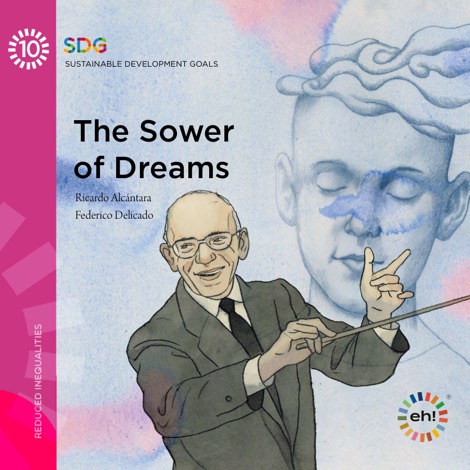
A pair of thin hands with long, dirty nails grabs Abril's, and she hears a boy sobbing. Alberto is standing outside his front door in the dark, afraid to go in. Inside, his stepfather takes the few coins Alberto has earned from begging, calls him useless, as he does every day, and reaches for his belt. For the first time, Alberto turns and runs. He falls asleep in a doorway and wakes to a thin, smiling man holding out a glass of milk and a biscuit. The man is José Antonio, and around him are children of different ages who look at Alberto as if they have always known him. He invites Alberto to come with them, to a house where there are no secrets, a hot shower, clean clothes and a teacher called Micaela who will teach him letters and numbers. Alberto is sure he will never learn anything. Then, after lunch, José Antonio leads everyone into a room full of instruments. The story is inspired by José Antonio Abreu, founder of El Sistema in Venezuela.
Themes to talk about
- Every child deserves the same chances
- Leaving violence behind and finding a safe place
- Music as a way to heal and to belong
- Believing in yourself after being told you are useless
- José Antonio Abreu and El Sistema
Questions to discuss
Ages 6 to 8
- What does José Antonio give Alberto when he wakes up in the doorway?
- How do the other children greet Alberto? How would you welcome a new child to your class?
- What does Alberto manage to write before lunch on his first day?
- How does Alberto feel when he hears the other children play their instruments?
Ages 9 to 11
- Alberto's stepfather keeps telling him he is useless. How do words like that stay with a person?
- The other children do not crowd Alberto with questions. Why do they understand how he feels?
- José Antonio says there are no secrets in the house. Why is it important that Alberto tells them what he thinks?
- Why does Micaela take Alberto's hand without saying a word when he freezes at the classroom door?
Ages 12 to 14
- José Antonio says, 'Music heals you; it shows you the best of yourself.' Do you agree? What else can do that for a young person?
- Alberto begs for coins instead of going to school. How does inequality pass from one generation to the next, and how can it be broken?
- José Antonio's project gives instruments and training to children from the poorest neighbourhoods. Why might that reduce inequality more than giving money alone?
- Research El Sistema in Venezuela: how many children have taken part, and what have some of them gone on to do?
Words to learn
- stepfather
- A man married to your mother who is not your birth father.
- begging
- Asking people in the street for money or food because you have none.
- abuse
- Hurting someone on purpose, with blows or with cruel words.
- orchestra
- A large group of musicians playing different instruments together.
- instrument
- An object used to make music, such as a violin, drum or flute.
- guest of honour
- The most important visitor at an event, given the best seat.
- inequality
- When some people have far fewer chances, money or rights than others.
- social exclusion
- Being shut out of things most people take part in, such as school, work or community life.
- Venezuela
- A country in South America, where José Antonio Abreu founded El Sistema.
Activities
20 minutes
A welcome for a newcomer
Materials
- Paper and pens
Steps
- List everything José Antonio and the children do to make Alberto feel welcome: milk and a biscuit, a shower, clean clothes, a seat at lunch.
- Talk about which of those things matter most, and why the children give him space.
- Write a short welcome plan for a new child joining your class or club.
- Choose one thing from the plan to try the next time someone new arrives.
30 minutes
Our own orchestra
Materials
- Homemade instruments: pots, spoons, rice in a bottle, rubber bands over a box
Steps
- Everyone makes or chooses one simple instrument.
- Pick a conductor who counts everyone in, as José Antonio does.
- Play a simple rhythm together, then take turns adding something new.
- Talk about how it felt to be part of a group where everyone's sound mattered.
20 minutes
Words that hurt, words that help
Materials
- Two colours of paper
- Pens
Steps
- On one colour, write the words that hurt Alberto, like his stepfather calling him useless.
- On the other, write words that could help him believe in himself.
- Talk about the people in the story who used helping words or kind actions.
- Throw away the hurting words and put the helping words up on the wall.
The link with SDG 10
Goal 10 aims to reduce inequality within and among countries, and Target 10.2 calls for the social, economic and political inclusion of everyone, whatever their age, sex, disability, race, ethnicity, origin, religion or economic status. The Sower of Dreams shows inclusion in action: a boy who begged in the street and was told he was useless is given food, safety, school and a place in an orchestra, the same chances other children take for granted.
All about SDG 10: Reduced Inequalities →Frequently asked questions
What age is The Sower of Dreams for?
This guide offers questions for three age bands: 6 to 8, 9 to 11 and 12 to 14. The opening pages show a boy being hit by his stepfather, so younger children are best reading it with an adult who can talk it through.
Which Sustainable Development Goal does The Sower of Dreams cover?
It covers Goal 10, Reduced Inequalities, through a story inspired by José Antonio Abreu, who brought music teaching to children from the poorest neighbourhoods of Venezuela.
Where can we read The Sower of Dreams?
The full book is in the Eco Heroes library, available to members with a family or school plan. This reading guide is public and can be used by anyone at home or in class.
Read the whole book
“The Sower of Dreams” is in the Eco Heroes library for members with a family or school plan. This guide is public: use it freely at home or in class.