
Reading guide · Goal 3 · Good Health
The House of Hope
Ages 6 to 14
A free reading guide for families and teachers: questions by age, vocabulary and activities.
About the story
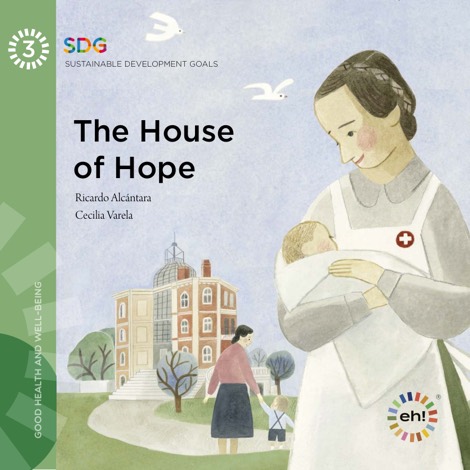
Leafing through a photo album, Abril finds a picture from a war that she cannot forget, so she lets her imagination carry her to a refugee camp in the south of France during the Second World War. Francisca has fled the Spanish Civil War and now sits on a sandy beach behind barbed wire, with almost no food, no water, no latrines and no shade. Her baby is nearly due, and she has already seen other women's babies die with no doctor or midwife to help. Nearby, Elisabeth Eidenbenz, a slight young Swiss woman with a big, stubborn personality, refuses to leave the mothers to their fate. She finds an abandoned mansion in Elna, gathers volunteers to repair it and stands up to the prefect, who does not want to give her permission to open a maternity home. Will Francisca reach the house in Elna in time? The book is inspired by the real Elisabeth Eidenbenz, whose Elna Maternity Hospital saved the lives of nearly 600 babies.
Themes to talk about
- Health care as a right, not a privilege
- Mothers and newborn babies in danger
- Refugees and life in a camp
- Courage in someone small and determined
- Elisabeth Eidenbenz and the Elna Maternity Hospital
Questions to discuss
Ages 6 to 8
- What is missing in the camp on the beach where Francisca is staying?
- Why does Francisca whisper to her baby that there is no rush to be born?
- What do Elisabeth and the volunteers do to the old mansion to make it look like new?
- Why does the driver honk the horn as he gets close to the house?
Ages 9 to 11
- The prefect says no to the maternity home. How does Elisabeth make him change his mind?
- In the house, the mothers will be treated like people, not animals. What do they get there that they did not have in the camp?
- Elisabeth tells the soldiers a lie to protect Rebeca. Was she right? When can a lie protect someone?
- After her baby is born, Francisca asks to stay and help. Why do you think she wants to?
Ages 12 to 14
- Francisca thanks Elisabeth for giving them back 'Hope and dignity'. Why does dignity matter for health?
- The prefect worried that welcoming any pregnant woman, whatever her origin or religion, would upset people. Why does health care for everyone sometimes meet resistance?
- The epilogue says there are big differences in care between countries and within them. Give examples of what makes the difference for a mother and her baby.
- Research the real Elna Maternity Hospital: who helped Elisabeth keep it running, and why did it matter so much?
Words to learn
- refugee camp
- A place where people who have fled war or danger are given shelter, often in very hard conditions.
- midwife
- A person trained to help women give birth and to care for mothers and new babies.
- maternity ward
- The part of a hospital or home where babies are born and mothers are cared for.
- latrine
- A simple toilet, often a hole in the ground.
- malnutrition
- Being ill or weak because you do not get enough food, or the right food.
- volunteer
- Someone who chooses to help without being paid.
- prefect
- In France, the official in charge of a region, who gives or refuses permission for many things.
- dignity
- Being treated as someone who matters and deserves respect.
- exile
- Someone forced to leave their own country.
Activities
25 minutes
Camp or house?
Materials
- A large sheet of paper folded in half
- Coloured pencils
Steps
- On one side, draw the camp on the beach as the book describes it: barbed wire, sand, no shade.
- On the other, draw the house in Elna once the volunteers have finished.
- List what each place has for a mother and a new baby: water, food, a bed, a midwife, medicine.
- Circle the three things you think make the biggest difference to health, and say why.
20 minutes
Persuade the prefect
Materials
- Role cards: Elisabeth and the prefect
- A few pictures cut from a magazine to stand for Elisabeth's photos
Steps
- In pairs, one plays Elisabeth and the other the prefect.
- Elisabeth explains why the maternity home must open and who it is for.
- The prefect gives his worries. Elisabeth answers them, using the photos as she does in the book.
- Swap roles, then talk about which arguments were hardest to answer.
30 minutes
A welcome box for a new baby
Materials
- A shoebox
- Paper, pens and scissors
Steps
- Make a list of what a mother and newborn baby need in the first days: warmth, clean water, food for the mother, a safe place to sleep, someone trained to help.
- Draw or write each item on a card and put it in the box.
- Compare the box with what Francisca had in the camp.
- Find out who looks after new mothers and babies where you live, such as midwives and health visitors.
The link with SDG 3
Goal 3 aims to ensure healthy lives and well-being for everyone at every age, and Target 3.1 is to reduce the number of mothers who die in pregnancy and childbirth, while Target 3.2 is to end preventable deaths of newborn babies. The House of Hope makes those targets concrete: in the camp, mothers give birth with no midwife, food or clean water; in the house in Elna, they have a clean bed, care and medicine.
All about SDG 3: Good Health →Frequently asked questions
What age is The House of Hope for?
This guide offers questions for three age bands: 6 to 8, 9 to 11 and 12 to 14. The book deals with war and with babies who did not survive, so younger children are best reading it with an adult who can talk it through.
Which Sustainable Development Goal does The House of Hope cover?
It covers Goal 3, Good Health and Well-being, through the story of Elisabeth Eidenbenz, who opened a maternity home in Elna for mothers from the refugee camps of southern France.
Where can we read The House of Hope?
The full book is in the Eco Heroes library, available to members with a family or school plan. This reading guide is public and can be used by anyone at home or in class.
Read the whole book
“The House of Hope” is in the Eco Heroes library for members with a family or school plan. This guide is public: use it freely at home or in class.