
Reading guide · Goal 17 · Partnerships
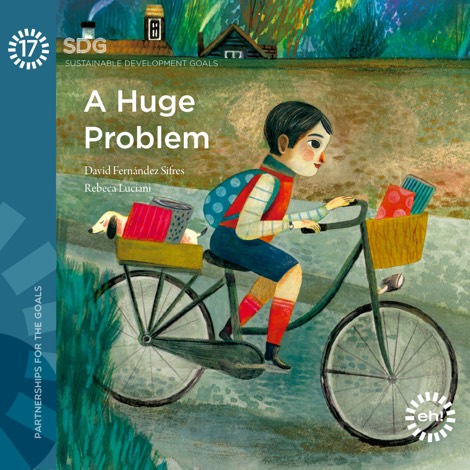
A Huge Problem
Ages 6 to 14
A free reading guide for families and teachers: questions by age, vocabulary and activities.
About the story
Abril comes out of school with her head down. Her class cannot agree where to go on their school trip, and they have even fallen out over it. Her father says he wants to tell her a story. Years ago in Portugal, a boy called António had a teacher like no other. Mr Pereira announced that the exam would not be marked at all: the class would pass only if they planned and took a trip to another country. There were two rules: if even one pupil could not afford it, the whole class would fail, and nobody was allowed to lend anyone money for the trip. All eyes turned to Fernando and Larissa, two new pupils whose families had sold almost everything to reach Portugal. António refuses to fail. When he learns that the new pupils know how to sew, an idea starts to take shape, but setbacks are waiting. Can a class turn a huge problem into a shared plan? The story is inspired by António Guterres, Secretary-General of the United Nations.
Themes to talk about
- Working together towards a shared goal
- Nobody left behind
- Welcoming newcomers and refugees
- Turning problems into opportunities
- António Guterres and the United Nations
Questions to discuss
Ages 6 to 8
- Why is Abril upset when she comes out of school?
- What are Mr Pereira's two rules for the school trip?
- What do Fernando and Larissa know how to make?
- What do the class make and sell at their stall? What would you make?
Ages 9 to 11
- Mr Pereira says, 'If even one person can't afford it, the whole class will fail.' Why do you think he made that rule?
- At first Nuno says Mr Pereira is doing it on purpose so they all fail. How does António see the challenge differently?
- Why is lending money for fabric and thread allowed when lending money for the trip is not?
- António tells Fernando and Larissa to organise things however they want. Why is it important that they are in charge of their own plan?
Ages 12 to 14
- Mrs Edison tears up António's plan and tells him to focus on what really matters. What did really matter in that lesson?
- When the first stall fails, António works out what needs to be sewn and sold each week. Why do good partnerships need numbers as well as good intentions?
- Fernando and Larissa's families came from a poorer country across the ocean. How does the class's plan mirror the way rich and poor countries could work together?
- Research António Guterres's work as UN High Commissioner for Refugees and as Secretary-General. How does this story connect with it?
Words to learn
- partnership
- People, groups or countries working together towards the same goal.
- afford
- To have enough money to pay for something.
- lend
- To give something, such as money, that will be paid back later.
- materials
- The things you need to make something, such as fabric and thread.
- stall
- A table or small stand where things are sold.
- sewing machine
- A machine that stitches fabric together much faster than sewing by hand.
- guayabera
- A light, decorated shirt worn in hot countries in Latin America and the Caribbean.
- refugee
- Someone who has had to leave their country to find safety or a better life.
- Secretary-General
- The person who leads the United Nations and speaks for it around the world.
Activities
30 minutes
Mr Pereira's challenge
Materials
- Paper and pens
- A pretend budget written on cards
Steps
- In groups, plan an imaginary class trip using Mr Pereira's two rules.
- Give each pupil a card showing how much they can pay. Some cards show nothing at all.
- Find a way for everyone to go without lending money for the trip itself.
- Share your plans and vote on the fairest one.
40 minutes
The class stall
Materials
- Simple craft materials: card, string, beads or fabric scraps
- A table and a hand-made poster
Steps
- Decide together what the class can make, as Fernando and Larissa sew caps and bags.
- Share out the jobs: making, posters, selling, counting.
- Work out how many items you need to make for a small target, as António does on his piece of paper.
- Hold the stall for a school cause and talk about what worked and what you would change.
20 minutes
Problem or opportunity?
Materials
- Paper folded in half
- Pens
Steps
- On the left, write a problem your class or family has, like Abril's school trip.
- On the right, write what each person could bring to solve it, as the new pupils bring their sewing.
- Find one way to turn the problem into an opportunity.
- Agree a first step and who will take it.
The link with SDG 17
Goal 17 aims to strengthen the global partnership for sustainable development, and Target 17.17 encourages effective partnerships that build on everyone's experience and resources. A Huge Problem shows a partnership in miniature: a whole class pooling money for materials, two new pupils bringing their sewing skills, and a plan in which nobody is left behind, the same idea that runs through all the Sustainable Development Goals.
All about SDG 17: Partnerships →Frequently asked questions
What age is A Huge Problem for?
This guide offers questions for three age bands: 6 to 8, 9 to 11 and 12 to 14. Younger children enjoy the school challenge and the stall; older readers can link the story to how countries work together.
Which Sustainable Development Goal does A Huge Problem cover?
It covers Goal 17, Partnerships for the Goals, through a story inspired by António Guterres, who as a schoolboy in Portugal faced a teacher with a seemingly impossible challenge.
Where can we read A Huge Problem?
The full book is in the Eco Heroes library, available to members with a family or school plan. This reading guide is public and can be used by anyone at home or in class.
Read the whole book
“A Huge Problem” is in the Eco Heroes library for members with a family or school plan. This guide is public: use it freely at home or in class.