
Reading guide · Goal 16 · Peace & Justice
The Torch of Peace
Ages 6 to 14
A free reading guide for families and teachers: questions by age, vocabulary and activities.
About the story
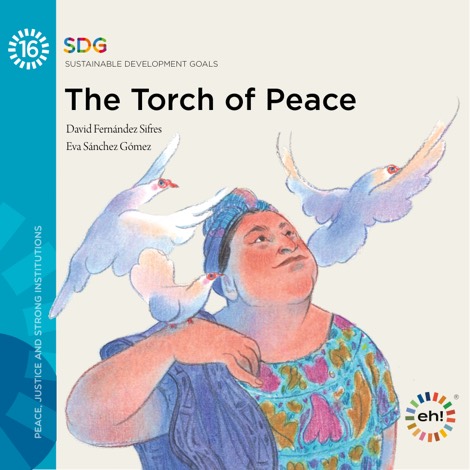
Every night Abril writes in her secret diary under the sheets, lighting the pages with a small torch topped by a white dove carrying an olive branch. It was a gift from a woman who spoke at her school, a refugee from a war-torn country, who told the class that peace, hope, justice and smiles go hand in hand. The story then moves to a magnificent hall where Rigoberta Menchú hears her name called to receive the Nobel Peace Prize. In the pocket of her colourful huipil she touches a bundle of tattered scraps of paper, and the memories come flooding back. She began picking cotton at five, from sunrise to sunset, under a cruel foreman. Her mother secretly taught her to read and write and told her about their Maya ancestors. One night a desperate man ran into their hut, pressed paper and a pencil into her hands and whispered something in her ear before he was dragged away. What did he tell her, and how will she end her speech? The story is inspired by Rigoberta Menchú.
Themes to talk about
- Peace, justice, hope and smiles go together
- Telling the truth about injustice
- Indigenous rights and the right to be counted
- Child labour and fair treatment at work
- Rigoberta Menchú and the Nobel Peace Prize
Questions to discuss
Ages 6 to 8
- What is on top of the torch the woman gives Abril? What does it stand for?
- Where does Abril write her diary every night? Why does she feel safe there?
- How old was Rigoberta when she started picking cotton? What did her mother teach her at night?
- The woman says that without justice you cannot laugh. What example does she give about raising hands in class?
Ages 9 to 11
- Why does the man in the hut give his papers and pencil to Rigoberta, and not to anyone else?
- The foreman says Itzé does not exist because he is not on his papers. Why does that make Rigoberta so angry?
- Rigoberta's mother says, 'Do not hate, but do not forget.' What is the difference between remembering and hating?
- Rigoberta's mother says some wounds can only be healed with words. What does Rigoberta do with her words?
Ages 12 to 14
- Rigoberta's mother says papers should never be more important than people, but sometimes people need papers. Why is being officially registered so important for children's rights?
- The plantation owner would never blame the foreman, so the girl is blamed instead. What does a fair justice system need so that the powerful are held to account too?
- Rigoberta writes down the truth of the victims for years before she can share it. Why is recording what happened so important for justice and peace?
- Research Rigoberta Menchú and the civil war in Guatemala: what happened to Indigenous communities, and what did she do afterwards?
Words to learn
- refugee
- Someone who has had to flee their country because of war or danger.
- dove
- A white bird that, with an olive branch in its beak, is a symbol of peace.
- huipil
- A colourful woven blouse worn by Maya women in Guatemala and Mexico.
- plantation
- A large farm where one crop, such as cotton, is grown by many workers.
- foreman
- The person in charge of a group of workers.
- Indigenous
- Describes the first peoples of a land and their descendants, such as the Maya.
- justice
- Fair treatment for everyone, and fair consequences when someone does wrong.
- human rights
- The basic rights every person has, such as life, safety, freedom and fair treatment.
- Guatemala
- A country in Central America, where Rigoberta Menchú was born.
Activities
20 minutes
Peace, hope, justice and smiles
Materials
- Four large cards labelled peace, hope, justice and smiles
- Pens
Steps
- Read out what the woman says to Abril's class about the four being a team.
- In groups, write on each card what that word looks like in your class or home.
- Take one card away. What happens to the others? Use the woman's example of raising hands.
- Agree on one thing you can do this week to keep all four together.
25 minutes
Write it down
Materials
- A small notebook or folded paper
- A pencil
Steps
- Talk about why Rigoberta kept her scraps of paper and why Abril keeps a diary.
- Think of something that happened which you thought was unfair, at school, in the news or in a story.
- Write it down simply: what happened, who it happened to, and what you think would have been fair.
- Discuss: who could you share it with to help put it right?
25 minutes
Everyone counts
Materials
- Paper and pens
- A copy of the UN Convention on the Rights of the Child in child-friendly language, from a library or website
Steps
- Remember Itzé, the two-year-old the foreman said did not exist.
- Find the right to a name and to be registered at birth in the convention.
- Make an identity card for Itzé with his name, age and parents, as Rigoberta writes in her notes.
- Talk about what other rights depend on being counted: school, health care, protection.
The link with SDG 16
Goal 16 aims to promote peaceful and inclusive societies, provide access to justice for all and build fair, accountable institutions. Target 16.9 calls for legal identity for everyone, including birth registration, and Target 16.2 calls for an end to the abuse and exploitation of children. The Torch of Peace shows both in a cotton plantation: a five-year-old picking cotton, and a two-year-old boy whom the foreman says does not exist.
All about SDG 16: Peace & Justice →Frequently asked questions
What age is The Torch of Peace for?
This guide offers questions for three age bands: 6 to 8, 9 to 11 and 12 to 14. Rigoberta's memories include violence and people who disappear, so younger children are best reading it with an adult who can talk it through.
Which Sustainable Development Goal does The Torch of Peace cover?
It covers Goal 16, Peace, Justice and Strong Institutions, through a story inspired by Rigoberta Menchú, the Maya Quiché leader who spoke out for the rights of Indigenous peoples in Guatemala.
Where can we read The Torch of Peace?
The full book is in the Eco Heroes library, available to members with a family or school plan. This reading guide is public and can be used by anyone at home or in class.
Read the whole book
“The Torch of Peace” is in the Eco Heroes library for members with a family or school plan. This guide is public: use it freely at home or in class.