
Reading guide · Goal 11 · Sustainable Cities
The Dog that Said Woof
Ages 6 to 14
A free reading guide for families and teachers: questions by age, vocabulary and activities.
About the story
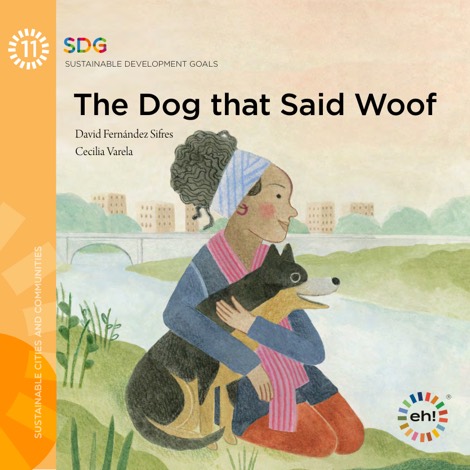
Abril has a new dog from the pound. His name is Jin, which means little devil in the Amazigh language, but Jin is tiny, never misbehaves, ignores sticks and bones and does not even chase Ramsés the cat. Abril's story then crosses the ocean to Majora Carter, a girl her own age who lives in the Bronx, in New York. The Bronx is said to be the most dangerous and dirtiest neighbourhood in the city: if a rubbish truck has nowhere to go, it is dumped there. Majora's family is about to move away, and her best friend Mathew's family is losing customers at their burger place. The two friends sit in their secret spot facing the mysterious mountain, a huge heap of rubble and scrap that towers over the buildings. Dogs from all over the neighbourhood keep disappearing through a small hole at its base. Where do they go? One Thursday, an enormous dog squeezes through the hole, and Majora decides to follow it. The story is inspired by the environmental activist Majora Carter.
Themes to talk about
- Making your own neighbourhood a better place
- Green spaces and clean surroundings for everyone
- Friendship and courage
- Rubbish, pollution and who has to live with them
- Majora Carter and the South Bronx
Questions to discuss
Ages 6 to 8
- What is Abril's dog called, and what does his name mean? Why does that make her father snort?
- What things does Abril try to teach Jin? What does he do instead?
- What is the mysterious mountain made of?
- Majora and Mathew imagine where the dogs go inside the tunnel. Where do you think they go?
Ages 9 to 11
- Why does everyone blame the Bronx when something bad happens in New York? Is that fair to the people who live there?
- Majora's father misses seeing the horizon. What has taken it away?
- Why does Majora not want to move, even though her neighbourhood is dirty and unsafe?
- When Mathew grabs Majora's ankle in the tunnel, he asks if she thought he would leave her alone. What does that tell you about their friendship?
Ages 12 to 14
- The book opens with 'Sometimes, a dog can change your life.' How do Jin and the huge dog each change things in the story?
- Rubbish from the whole city ends up in the Bronx. Why do poorer neighbourhoods often end up with the dumps, the fumes and the traffic?
- Majora believes you do not have to move away to have a better life. What would a neighbourhood need for people to want to stay?
- Research Hunts Point Riverside Park and Majora Carter's work: what did the community do, and what changed for local families?
Words to learn
- pound
- A place that takes in lost or unwanted dogs until someone adopts them.
- neighbourhood
- An area of a town or city where people live close to each other.
- landfill
- A huge site where rubbish is dumped and buried.
- debris
- Broken pieces of things that have been thrown away or destroyed.
- toxic fumes
- Smoke or gases that are poisonous to breathe.
- horizon
- The line far away where the sky seems to meet the land or the sea.
- tunnel
- A narrow underground or covered passage.
- meadow
- A field of grass and wild flowers.
- Amazigh
- The language and people native to North Africa, also called Berber.
Activities
30 minutes
Map my neighbourhood
Materials
- A large sheet of paper
- Coloured pencils
- A walk around the block with an adult
Steps
- Walk around your block and notice green spaces, rubbish, bus stops and places to sit.
- Draw a map, marking places you love in green and places that need help in red.
- Compare your map with the Bronx as Majora first describes it.
- Choose one red spot and suggest what could make it green.
25 minutes
Majora's plan
Materials
- Paper and pens
- Old magazines, scissors and glue
Steps
- Imagine you are Majora standing in front of the mysterious mountain. What would the space look like if it were cleared?
- Make a collage of your plan: trees, benches, a fountain, picnic tables, a bus stop.
- Add who would need to help: neighbours, the council, local shops.
- Present your plan to the group and explain who it is for.
20 minutes
Where does our rubbish go?
Materials
- A day's rubbish from one bin, with gloves
- Paper and pencil
Steps
- Wearing gloves, sort a day's rubbish into piles: food, paper, plastic, glass, other.
- Count what could have been recycled, reused or avoided.
- Find out from your local council where the rest is taken.
- Talk about who lives near that place, and how it might feel to live next to a mountain of other people's rubbish.
The link with SDG 11
Goal 11 aims to make cities and communities inclusive, safe, resilient and sustainable, and Target 11.7 calls for safe, inclusive and accessible green and public spaces for everyone, while Target 11.6 asks cities to reduce their environmental impact, including how they manage waste. The Dog that Said Woof shows a neighbourhood buried under the city's rubbish and two children who refuse to accept that it has to stay that way.
All about SDG 11: Sustainable Cities →Frequently asked questions
What age is The Dog that Said Woof for?
This guide offers questions for three age bands: 6 to 8, 9 to 11 and 12 to 14. Younger children love Jin and the mystery of the tunnel; older readers can explore why some neighbourhoods carry more pollution than others.
Which Sustainable Development Goal does The Dog that Said Woof cover?
It covers Goal 11, Sustainable Cities and Communities, through a story inspired by Majora Carter, who worked to turn neglected spaces in the South Bronx into green areas for local families.
Where can we read The Dog that Said Woof?
The full book is in the Eco Heroes library, available to members with a family or school plan. This reading guide is public and can be used by anyone at home or in class.
Read the whole book
“The Dog that Said Woof” is in the Eco Heroes library for members with a family or school plan. This guide is public: use it freely at home or in class.