
Reading guide · Goal 5 · Gender Equality
Isabel's Bright Ideas
Ages 6 to 14
A free reading guide for families and teachers: questions by age, vocabulary and activities.
About the story
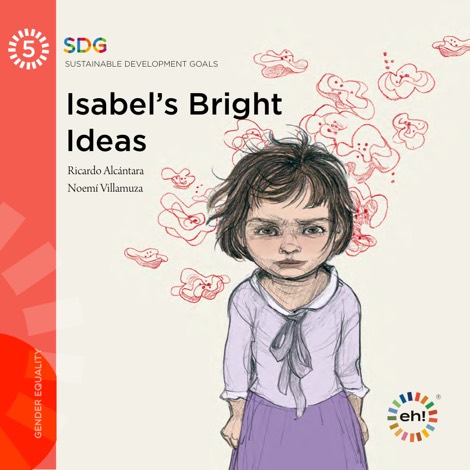
Like every Thursday, Abril calls in at the library after school and takes home a book whose author describes herself as a scared little girl full of fears. Abril closes her eyes and builds her own story about that girl: Isabel, the eldest of three children, who is inspired by the writer Isabel Allende. One night Isabel hears her parents talking; the next morning her mother, Panchita, is crying in an armchair because Isabel's father has gone and is not coming back. Isabel has to leave her toys behind and move with her mother and brothers to her grandparents' big, dark house in Chile. There she watches the maids working from dawn to dusk and hears that a woman without a husband has failed. Why must she help to set the table when her brothers never do? Why should girls be well-behaved and quiet? Her grandmother is shocked, and her mother even takes her to the doctor. What will Isabel do with all those questions?
Themes to talk about
- Questioning rules that treat girls and boys differently
- Speaking up when something is not fair
- Fear, family change and finding your voice
- Women's work at home and the rights of domestic workers
- Isabel Allende and equal opportunities
Questions to discuss
Ages 6 to 8
- What does Isabel have to leave behind when the family moves? What does the family find room for in the big suitcase?
- What is Isabel's grandparents' house like? Why does it frighten her?
- Why is Isabel cross about setting the table? What would you have said?
- Isabel's grandmother says girls should be well-behaved and obedient. What do you think girls and boys should be?
Ages 9 to 11
- Isabel's grandmother asks, 'Since when do girls raise their voices?' Why do you think she believes that?
- Isabel learns a lot by listening at doors and crawling towards the living room. What does she find out that nobody tells her directly?
- What does Isabel notice about the maids' lives? Why does it make her angry?
- Panchita takes Isabel to the doctor because of her attitude. What does that tell you about how people saw girls who spoke out?
Ages 12 to 14
- Isabel's stubborn, determined personality is called a positive trait in men but is not accepted in her. Where do you still see that double standard today?
- Panchita says, 'The world is how it is and it's always been that way.' Isabel cannot accept that. Who do you agree with, and why?
- Isabel says she does not want to be angry with herself for staying quiet. When is speaking up worth upsetting people you love?
- Research Isabel Allende's life and her foundation: how did the girl in this story grow into the woman described in the epilogue?
Words to learn
- rebel
- To refuse to obey rules or people you think are unfair.
- authority
- The power to give orders and make decisions for others.
- inquisitive
- Always wanting to know and find things out.
- siblings
- Brothers and sisters.
- maid
- A woman paid to clean, cook and look after a house that is not her own.
- obedient
- Doing what you are told without arguing.
- outspoken
- Saying exactly what you think, even when others do not like it.
- injustice
- A situation where people are not treated fairly.
- feminist
- Someone who believes women and men should have the same rights and opportunities.
Activities
20 minutes
Who does what at home?
Materials
- A large sheet of paper
- Pens
Steps
- List the jobs that need doing at home in a week: setting the table, cooking, washing, tidying, shopping.
- Next to each job, write who usually does it.
- Compare your list with Isabel's house, where she sets the table and her brothers never do.
- Agree on one change you could make so the jobs are shared more fairly.
25 minutes
Isabel's questions
Materials
- Paper and pencils
Steps
- Write down three questions Isabel asks or thinks in the book.
- Add one question of your own about something you think is unfair between girls and boys.
- Read the questions aloud and answer them as Isabel's grandmother would, then as Isabel would.
- Talk about how the answers have changed since Isabel was a girl, and what still needs to change.
25 minutes
A letter to Isabel
Materials
- Writing paper
- Coloured pencils
Steps
- Imagine you could write to Isabel on the day she arrives at her grandparents' house.
- Tell her what you think of her ideas and how you would feel in her place.
- Add a drawing of something that would make her feel less afraid in that dark house.
- Share the letters and notice how many different kinds of support people chose to give.
The link with SDG 5
Goal 5 aims to achieve gender equality and empower all women and girls, and Target 5.4 asks that unpaid care and domestic work be recognised and shared within the family. Isabel's Bright Ideas starts right there, at the dining table: Isabel helps to set it and her brothers never do. Through her questions about the maids, her mother and her own future, children see how equality begins with everyday rules.
All about SDG 5: Gender Equality →Frequently asked questions
What age is Isabel's Bright Ideas for?
This guide offers questions for three age bands: 6 to 8, 9 to 11 and 12 to 14. The book touches on parents separating, so younger children may like to read it with an adult who can talk it through.
Which Sustainable Development Goal does Isabel's Bright Ideas cover?
It covers Goal 5, Gender Equality, through a story inspired by the childhood of the writer Isabel Allende, who grew up questioning why girls and boys were treated differently.
Where can we read Isabel's Bright Ideas?
The full book is in the Eco Heroes library, available to members with a family or school plan. This reading guide is public and can be used by anyone at home or in class.
Read the whole book
“Isabel's Bright Ideas” is in the Eco Heroes library for members with a family or school plan. This guide is public: use it freely at home or in class.