
Reading guide · Goal 8 · Decent Work
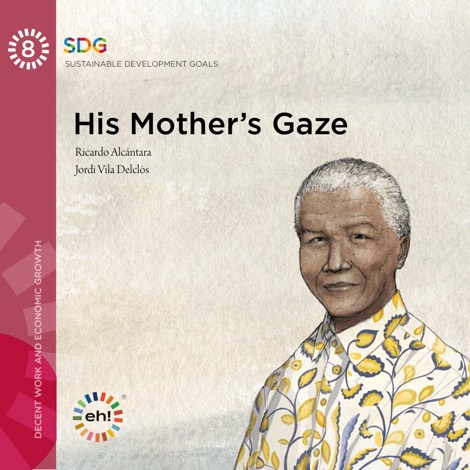
His Mother's Gaze
Ages 6 to 14
A free reading guide for families and teachers: questions by age, vocabulary and activities.
About the story
Abril has been wondering how anyone could bear to be locked up in prison, and her imagination carries her far away to Robben Island in South Africa. In a stone prison patrolled by armed guards and dogs, a prisoner named Nelson sleeps on straw under three worn blankets in a cell so small that his head and feet touch opposite walls. He has been sentenced to life for defending his people and asking for equal rights and an education for everyone, black and white. By day he breaks rocks into gravel; at night he looks past the bars at the moon and the clouds and travels back in time. He remembers being Rolihlahla, a shepherd boy in his village, the day his father dressed him for school in cut-down trousers tied with rope, and the British teacher who gave him a new name. Above all he remembers his mother's eyes when he came home at dusk. How can one look give a man strength? The story is inspired by Nelson Mandela.
Themes to talk about
- Equal rights and fair chances for everyone
- Hope and dignity in the hardest conditions
- Child labour, school and the right to an education
- The strength that love and memories can give
- Nelson Mandela and the struggle against apartheid
Questions to discuss
Ages 6 to 8
- What is Nelson's cell like? What does he sleep on?
- What did Nelson do every day when he was a little boy in his village?
- How does Nelson's father make him clothes for his first day at school?
- What does Nelson's mother tell him with only her eyes? Who looks at you that way?
Ages 9 to 11
- Why was Nelson sent to prison? What was he asking for?
- The teacher gives every child an English name because she cannot pronounce African names. How would you feel if your name was changed at school?
- Nelson's parents could not read or write, so they were determined to send him to school. Why?
- When reality hits too hard, Nelson looks at the world with different eyes. What does he look at instead of the bars?
Ages 12 to 14
- Nelson repeats that 'Children are not only the future of society but the future of ideas.' What do you think he means?
- In prison, Nelson breaks rocks for hours. Compare that work with what the epilogue calls decent work: a fair income, security and protection for your family.
- Nelson believes his friends outside will not rest until child labour has ended and all children have health and an education. Why might child labour keep a whole country poor?
- Research apartheid in South Africa: what was it, and how did it shape the work and pay people could get?
Words to learn
- apartheid
- A system of laws in South Africa that kept black and white people apart and gave white people more rights.
- cell
- A small locked room in a prison.
- gravel
- Small broken stones, used for paths and roads.
- kraal
- A group of huts, or an enclosure for animals, in a southern African village.
- shepherd
- Someone who looks after sheep and other grazing animals.
- tunic
- A simple loose piece of clothing worn over the body.
- discrimination
- Treating people unfairly because of who they are, such as their skin colour.
- child labour
- Work that children are made to do which harms them or keeps them out of school.
- decent work
- A job that pays fairly, is safe and protects you and your family.
Activities
25 minutes
Two places, one man
Materials
- A large sheet of paper folded in half
- Coloured pencils
Steps
- On one side, draw Nelson's cell on Robben Island as the book describes it.
- On the other, draw the village where Rolihlahla grew up: pastures, a stream, his mother's kraal.
- Write words for how each place feels.
- Talk about how remembering the village helps Nelson in the cell.
20 minutes
What makes work decent?
Materials
- Cards with jobs from the book: shepherd boy, prisoner breaking rocks, teacher, guard
- Paper and pens
Steps
- Agree on a checklist for decent work: fair pay, safety, rest, respect, and no children doing it.
- Hold each card up and check it against the list.
- Talk about why breaking rocks in prison is not decent work, and why a five-year-old shepherd raises questions too.
- Add one job someone in your family does and check it against the list.
20 minutes
The story of my name
Materials
- Paper and coloured pencils
Steps
- Find out why you were given your name and what it means, as Rolihlahla means rebellious.
- Write your name in large letters and decorate it with things that matter to you.
- Share the stories of your names in the group.
- Talk about why being given a new name at school might have felt strange to Nelson.
The link with SDG 8
Goal 8 aims to promote decent work for all, and Target 8.7 calls for an end to child labour in all its forms, while Target 8.5 asks for equal pay for work of equal value. His Mother's Gaze links both to Nelson's struggle: equal chances for black and white people, an end to child labour, and school for every child, so that work can give families a fair income and real security.
All about SDG 8: Decent Work →Frequently asked questions
What age is His Mother's Gaze for?
This guide offers questions for three age bands: 6 to 8, 9 to 11 and 12 to 14. Younger children connect with the memories of Rolihlahla's childhood; older readers can explore apartheid and fair work.
Which Sustainable Development Goal does His Mother's Gaze cover?
It covers Goal 8, Decent Work and Economic Growth, through a story inspired by Nelson Mandela, who in his prison cell remembers his childhood and his mother's loving look.
Where can we read His Mother's Gaze?
The full book is in the Eco Heroes library, available to members with a family or school plan. This reading guide is public and can be used by anyone at home or in class.
Read the whole book
“His Mother's Gaze” is in the Eco Heroes library for members with a family or school plan. This guide is public: use it freely at home or in class.